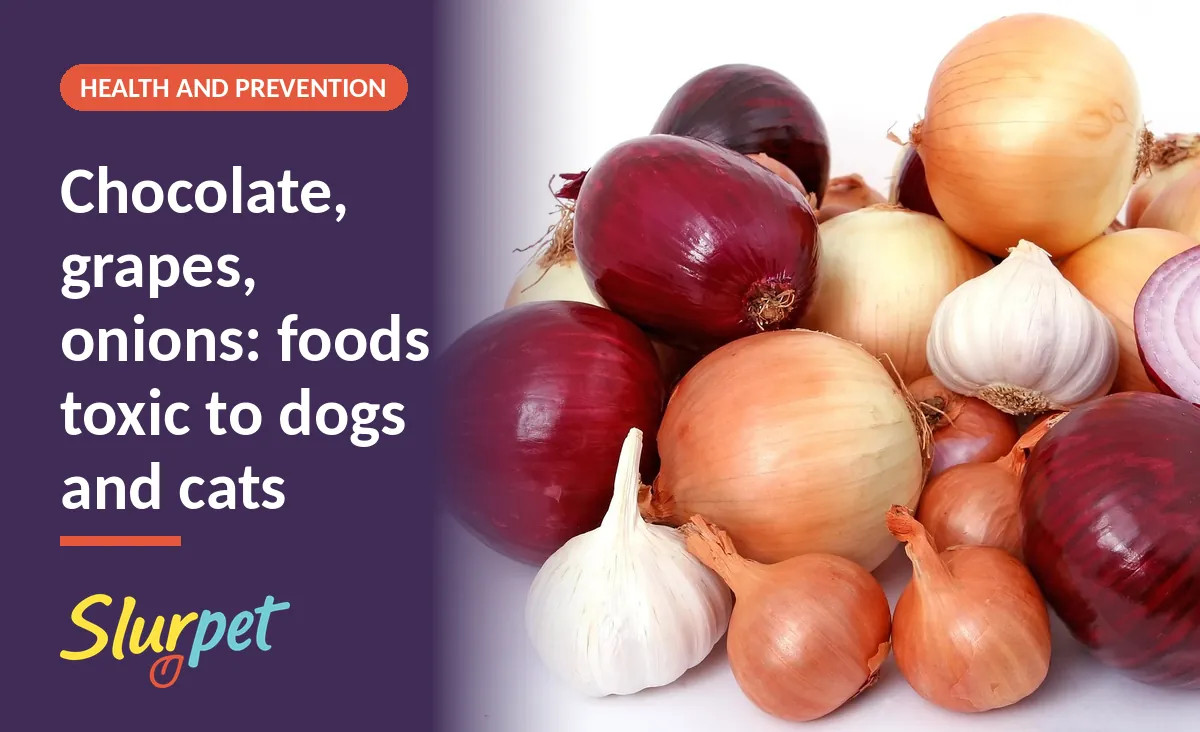
The most common foods toxic to dogs and cats in your kitchen are chocolate, grapes and raisins, onions and garlic, and xylitol, the sweetener in sugar-free products. Small amounts can cause vomiting, kidney damage, anaemia or a crash in blood sugar. The practical rule: keep them out of reach and, if your pet has eaten any, call your vet straight away.
In short
- Dark chocolate and cocoa powder are far more dangerous than milk chocolate; white chocolate contains negligible amounts of the toxic substances.
- Grapes and raisins can damage a dog’s kidneys even in small amounts, and there is no amount considered safe.
- Onions, garlic, leeks and chives damage red blood cells: cats are the most sensitive species, and powders and dried mixes are the most concentrated forms.
- Xylitol (E967), the sweetener in sugar-free gum and sweets, can make a dog’s blood sugar plummet within half an hour.
- If you suspect poisoning, don’t wait for symptoms: call your vet and take the packaging with you.
Which foods are most dangerous for dogs and cats?
The most dangerous are the ones we have at home every day: chocolate, grapes and raisins, onions and garlic, xylitol, macadamia nuts, raw yeast dough and alcohol.
What is a harmless snack for a person can become an emergency for an animal weighing just a few kilos. Here is an overview based on the MSD (Merck) Veterinary Manual and the ASPCA Animal Poison Control Center.
| Food | Why it is dangerous | Who is most at risk | When signs appear |
|---|---|---|---|
| Chocolate and cocoa | Theobromine and caffeine (methylxanthines): vomiting, restlessness, arrhythmias, seizures | Dogs, especially with dark chocolate and cocoa | Usually within 6-12 hours |
| Grapes, raisins (and tamarind) | Probably tartaric acid: kidney damage | Dogs | Vomiting or diarrhoea within 6-12 hours, kidney failure within 24-72 hours |
| Onions, garlic, leeks, chives | Damage to red blood cells and anaemia | Cats more than dogs | Often after a few days |
| Xylitol (E967) | Blood sugar crash and possible liver damage | Dogs | From 30 minutes up to 12-18 hours |
| Macadamia nuts | Weakness, tremors, high temperature | Dogs | Within 12 hours |
| Raw yeast dough | The stomach swells and the yeast produces alcohol | Mainly dogs | Variable |
| Alcohol | Vomiting, poor coordination, breathing difficulties, coma | Dogs and cats | Variable |
Why is chocolate bad for dogs (and cats)?
Because it contains theobromine and caffeine, substances called methylxanthines that overstimulate an animal’s heart and nervous system.
According to the MSD Veterinary Manual, in dogs the first mild signs (thirst, vomiting, diarrhoea) can appear at around 20 mg of methylxanthines per kilo of body weight, effects on the heart above 40-50 mg/kg and seizures from 60 mg/kg upwards. Symptoms usually appear within 6-12 hours: restlessness, tremors, a racing heart, high temperature.
The type of chocolate makes all the difference. The darker and more bitter it is, the more dangerous:
| Type | Methylxanthines per gram (approx.) |
|---|---|
| Unsweetened cocoa powder | 28.5 mg |
| Unsweetened baking chocolate | 15.5 mg |
| Dark and semi-sweet chocolate | 5.3-5.6 mg |
| Milk chocolate | 2.3 mg |
| White chocolate | 0.04 mg (negligible) |
To get a sense of scale, take a 10 kg dog. If it eats 50 g of milk chocolate, it takes in about 115 mg of methylxanthines, or roughly 11.5 mg/kg. If it eats 50 g of dark chocolate, it reaches about 27 mg/kg, already above the threshold for the first symptoms. A whole 100 g bar of dark chocolate means about 55 mg/kg, in the range where the heart can be affected. Just 10 g of cocoa powder, a couple of spoonfuls, is enough to exceed 28 mg/kg. These calculations explain why dark chocolate is more worrying, but they are not a way to decide whether to wait: call your vet anyway.
What about cats? They are rarely attracted to sweet things, but chocolate still appears among the household poisons listed by International Cat Care. The same substances are dangerous for them too: keep sweets, chocolate spreads and cocoa out of reach. Be careful with coffee and caffeine products as well, since caffeine is a methylxanthine like theobromine. With Halloween and the festive season coming up, watch out for sweets and chocolates left on the sofa.
Grapes and raisins: how many does it take to cause harm?
Only a few, and there is no amount considered safe: in dogs, grapes and raisins can cause acute kidney injury, even though not every dog reacts in the same way.
The main hypothesis, reported by both the MSD Veterinary Manual and the ASPCA, is tartaric acid: dogs lack the transporters needed to eliminate it, so it builds up in the kidney cells. The same substance is found in tamarind. According to the MSD Manual, even more than one grape or raisin per 4.5 kg of body weight may contain enough tartaric acid to put the kidneys at risk.
The first signs are vomiting or diarrhoea within 6-12 hours, followed by tiredness, loss of appetite, abdominal pain and thirst. Kidney failure itself can develop within 24-72 hours: that is why vets act immediately, before the kidneys stop working. In cats there are only anecdotal reports, with no published cases, but caution applies to them too.
Where do raisins hide? In Christmas cake, mince pies and hot cross buns, in biscuits, in muesli and cereal bars, and in trail mixes.
Onions and garlic: why are they more dangerous for cats?
Because onions, garlic, leeks and chives contain compounds that damage red blood cells and can cause anaemia, and cats are the most sensitive species, followed by dogs.
The MSD Veterinary Manual reports cases in cats after eating less than a teaspoon of cooked onion, or 5 g of raw onion per kilo of body weight. In dogs, symptoms have appeared after 15-30 g of raw onion per kilo. Garlic is 3 to 5 times more toxic than onion.
Cooking does not remove the risk: onions and garlic are dangerous raw, cooked, dried or granulated. In fact, concentrated forms such as onion powder, garlic granules, stock cubes and packet soups are the most frequent cause of poisoning. That is why leftover sauces, gravy, roasts, pizza and ready meals should never end up in the bowl.
Symptoms are delayed: damage to red blood cells peaks after about 3-5 days. Your pet may seem tired, eat less, breathe faster, have pale or yellowish gums or dark urine. If you remember that a few days earlier it ate leftovers containing onion or garlic, tell your vet.
What is xylitol and where is it hidden?
Xylitol is a sweetener used in sugar-free products. It is safe for people, but in dogs it triggers a massive release of insulin and a crash in blood sugar.
According to the MSD Veterinary Manual, a dog’s blood sugar can drop at doses above about 100 mg per kilo of body weight, while above 500 mg/kg some dogs develop severe liver damage. Hypoglycaemia can appear within 30 minutes, or up to 12-18 hours later if the xylitol is in a gum that slows its absorption. Signs of liver damage can appear after 24-48 hours.
Where you find it: sugar-free chewing gum and sweets, mints, some peanut butters, “sugar-free” cakes and baked goods, toothpastes, chewable vitamins and supplements, some syrups and liquid medicines for people. On the label it may appear as xylitol or under the code E967. The MSD Manual states that xylitol does not have these effects in cats, but it is still a product for people: don’t share it with either.
If you use peanut butter to fill a toy, always check the ingredients.
Which other foods should you keep away from the bowl?
Beyond the four big dangers, some foods cause serious problems or digestive upsets.
- Macadamia nuts: in dogs, symptoms have appeared with as little as 2.4 g per kilo. They cause weakness, tremors, vomiting and a high temperature, which usually pass within 12-48 hours.
- Raw yeast dough: it keeps rising in the warm stomach, swells it and produces alcohol. A dog may become wobbly and have a drop in blood sugar.
- Coffee and caffeine products: caffeine is a methylxanthine, with effects similar to chocolate.
- Very salty foods: too much salt causes intense thirst, vomiting, diarrhoea and, in severe cases, seizures. Watch out for cured meats and crisps.
- Fatty nuts (almonds, walnuts, pecans): high in fat, they can cause vomiting, diarrhoea and, in some animals, pancreatitis.
- Cooked bones: they can splinter and injure or block the gut, sometimes to the point of needing surgery.
- Milk and dairy: many animals produce little lactase, the enzyme that digests lactose, and can get diarrhoea.
And one exception to remember for cats, even though it is not a food: lilies. According to International Cat Care, less than one leaf, or a little pollen licked off the coat, is enough to cause kidney failure. If you have a cat, avoid lilies in bouquets in the kitchen and around the home.
Are cats safer than dogs?
No: cats are pickier at the table, but they are not protected from poisoning. International Cat Care is clear about it: it is a misconception that cats, being fussy eaters, are less at risk than dogs.
Dogs swallow whatever they find more readily, but cats are more sensitive to some substances, such as onions and garlic, and they groom themselves: whatever settles on their coat, like lily pollen, ends up in their mouth.
What should you do if your dog or cat has eaten something toxic?
Call your vet or an emergency vet straight away, even if your pet seems fine: with many of these foods, symptoms appear hours or days later, when treatment is more difficult.
- Move your pet away from the food and remove what is left, so it can’t eat any more.
- Try to work out what it ate, how much and when, and have your pet’s weight to hand.
- Phone your vet and describe everything. At night or on bank holidays, contact an emergency veterinary clinic.
- Don’t make your pet vomit on your own initiative and don’t give milk, oil or home remedies: your vet will decide whether and how to act.
- Take the packaging, the label or a photo with you and, if possible, a sample of any vomit.
- Over the following days, watch for tiredness, loss of appetite, thirst, dark urine or pale gums and report any change.
How can you prevent poisoning at home and during the holidays?
Simple habits and clear rules for the whole family are all it takes. Use this checklist:
- Store chocolate, nuts, raisins and sweets in closed cupboards or up high.
- Use a bin with a lid your dog can’t open.
- Don’t leave plates and pans unattended on the table or the hob.
- Explain to children and guests that they mustn’t give food from their plate: even “a little bit” can be too much for a small animal.
- Don’t leave bags and coats with gum, sweets or chocolates in the pockets within sniffing distance.
- Keep your pet in another room while you bake with yeast dough or when you are eating with lots of guests.
- Check the labels of the sugar-free products you have at home and keep them out of reach.
- If you have a cat, choose flowers without lilies.
- Save your vet’s number and that of an emergency clinic near you in your phone.
Frequently asked questions
Is white chocolate dangerous for dogs?
White chocolate contains negligible amounts of theobromine and caffeine, so the risk of poisoning is very low. It is still high in fat and sugar, though, and can upset the stomach: it is not a suitable treat.
My dog ate one grape: what should I do?
Call your vet even if it was just one grape. There is no amount considered safe and sensitivity varies from dog to dog, so your vet will assess each case individually.
Can a little gravy with onion harm my cat?
Yes, cats are very sensitive and cases have been described with less than a teaspoon of cooked onion. Symptoms may appear after a few days, so talk to your vet even if your cat seems fine.
Can cats drink milk?
Like many animals, cats produce little lactase, the enzyme that digests lactose, and milk can give them diarrhoea. It is not a necessary food: fresh water is always the best choice.
This article is for information only and does not replace your vet’s advice. If you think your dog or cat has eaten something dangerous, contact your vet straight away.
Slurpet products for safe rewards
The safest way to reward your pet is to use treats made for dogs and cats instead of table leftovers, counting them in the daily ration.
- Monge Gift Sticks Training fresh duck and spirulina: bite-sized treats for adult dogs of all sizes, handy as rewards on walks and during training.
- Monge Gift Dental Sticks Medium-Maxi duck and mint: chews for adult medium and large dogs, an alternative to cooked bones.
- Monge Gift Filled and Crunchy Dental rabbit and mint: filled kibbles for adult cats, to offer as a reward instead of milk or leftovers.
- Monge Gift Soft Sticks Kitten fresh trout and chamomile: soft treats for kittens, useful for getting them used to suitable rewards from an early age.
You can find the full range in For your dog and For your cat.
Read also: Most common dog and cat feeding mistakes: what to avoid · How to read dog and cat food labels
Sources
- MSD/Merck Veterinary Manual, Chocolate Toxicosis in Animals
- MSD/Merck Veterinary Manual, Grape, Raisin, and Tamarind Toxicosis in Dogs
- MSD Veterinary Manual, Garlic and Onion (Allium spp) Toxicosis in Animals
- MSD/Merck Veterinary Manual, Xylitol Toxicosis in Dogs
- MSD/Merck Veterinary Manual, Macadamia Nut Toxicosis in Dogs
- MSD/Merck Veterinary Manual, Bread Dough Toxicosis in Animals
- ASPCA Animal Poison Control Center, People Foods to Avoid Feeding Your Pets
- International Cat Care, Cats and poisons