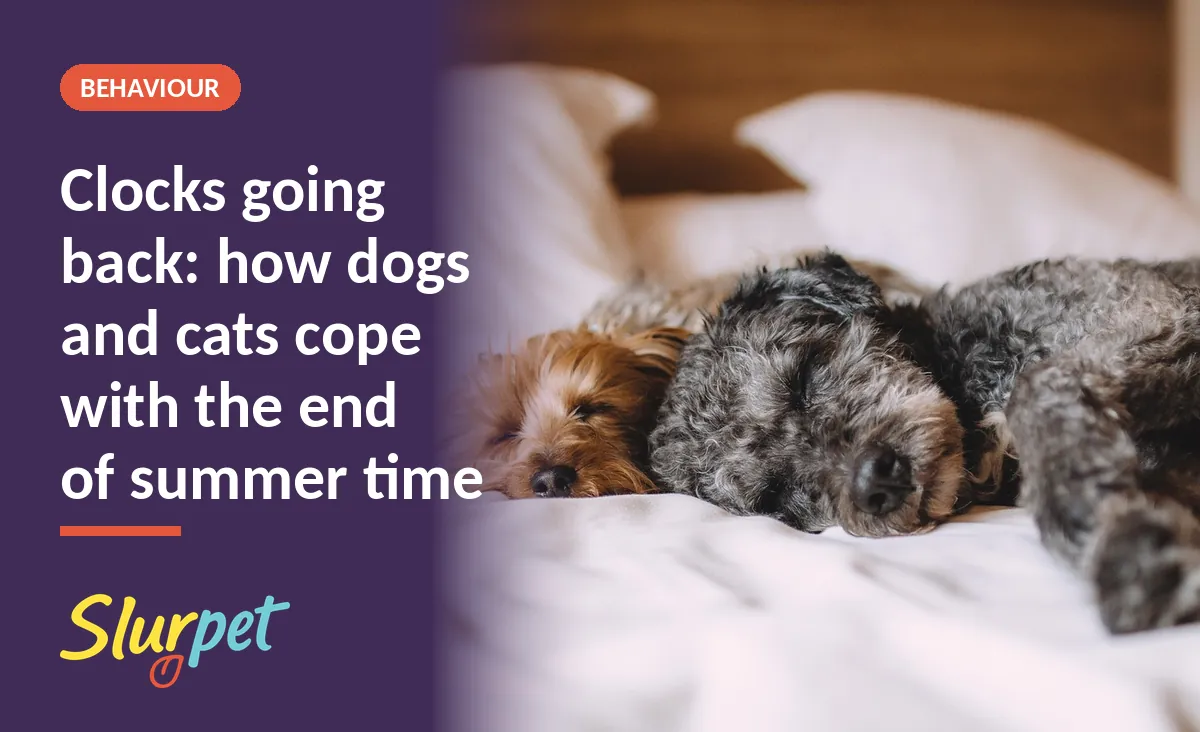
When the clocks go back, your dog and cat won’t face a serious problem, but they will notice it for a few days: on Sunday 25 October 2026 the clocks fall back one hour, and meals, walks and your alarm suddenly shift. Your pet doesn’t read the clock, it follows you. Here is how pets experience the change and how to help them.
In brief
- In Italy and the rest of the EU the clocks go back from 3:00 to 2:00 in the night between Saturday 24 and Sunday 25 October 2026; in the UK and Ireland they go back from 2:00 to 1:00 the same night.
- Dogs and cats set their day mainly by our habits (meals, walks, household noises) rather than by daylight.
- A University of Toronto study (2025) found that family dogs adapt well, while older dogs are more affected by sudden changes.
- The easiest strategy: shift meals and walks by 10 to 15 minutes a day, before or after the change.
- If loss of appetite, vomiting, restlessness at night or toileting accidents appear after a few days, talk to your vet.
When do the clocks go back in 2026?
Summer time ends in the night between Saturday 24 and Sunday 25 October 2026. In the UK, according to GOV.UK, the clocks go back one hour at 2:00 on Sunday 25 October, returning to Greenwich Mean Time (GMT). In Ireland and the rest of the European Union, EU Directive 2000/84/EC sets the end of summer time on the last Sunday in October, at the same moment in every member state: in Italy, for example, the clocks go from 3:00 back to 2:00.
Do dogs and cats notice the clock change?
Yes, but not because of the clock: they notice it because our habits change. Their internal clock is set mainly by what we do: when we get up, when we open the food tin, when we pick up the lead.
The first study to measure the effect of the clock change on dogs was published in PLOS ONE in January 2025 by a team at the University of Toronto. Researchers fitted motion sensors to 25 sled dogs and to 29 family dogs and their owners in Ontario during the autumn change:
- the sled dogs, whose fixed schedules were set by their handlers, were more active than usual before people arrived on the Sunday of the change, in other words they were “waiting” on the old time; they readjusted in about a day;
- the family dogs did not change their morning activity, even though their owners got up earlier on weekdays;
- older family dogs were less active on the first morning after the change, and the authors advise owners of older dogs to introduce changes to routine with particular care.
Their conclusion is that flexible routines and gradual changes help dogs adapt. There are no specific studies on cats and the clock change, but the AAFP and ISFM Feline Environmental Needs Guidelines (from the international feline veterinary associations) point out that predictability, familiarity and routine help cats cope with change and reduce stress.
What changes in practice when the clocks go back?
In autumn your pet’s body is “one hour ahead” of the clock: if it used to eat at 8:00, after the change it will already be hungry at 7:00. If you keep feeding at 8:00 on the new clock, for your pet the meal arrives an hour late.
The most common situations in the following days:
- early wake-up calls: the dog asking to go out or the cat meowing at 6:00, because for them it is the usual 7:00;
- hunger “too early”: insisting by the bowl, the cat following you into the kitchen;
- evening walks in the dark: the sun sets earlier, so the after-work walk happens with little light and poor visibility.
Veterinary behaviourist Carlo Siracusa of the University of Pennsylvania explained to National Geographic that what matters more than the clock change itself is the change in people’s habits that comes with it, along with the change of season.
Which pets are most affected by the clock change?
The pets most affected are creatures of habit, older animals and those that are already a little anxious; healthy young adults usually barely notice.
| Who | What can happen | What to do |
|---|---|---|
| Puppy or kitten | Frequent meals and toilet needs close together: a one-hour difference is felt at once | Keep the meal-outing-rest sequence and shift times in small steps |
| Healthy adult | Usually adapts within a few days, with a few early requests | A gradual or even immediate change, with a little patience |
| Older dog | More sensitive to sudden changes; less active on the first morning in the Toronto study | Start a few days early and go slowly |
| Older cat | May become more demanding or restless at night | Stable routine and an evening meal close to bedtime |
| Anxious pet | Any novelty can increase restlessness and demands | Maximum predictability, no other changes during those days |
| Fixed meal or treatment times | Timing matters for health reasons too | Ask your vet how to handle the change |
How can you help your dog and cat adjust?
The simplest way is to shift meals and walks by 10 to 15 minutes a day, so the new time arrives without a jolt. You can do this before the change or after it.
The “before” method (recommended for older and anxious pets). From Wednesday 21 October, move meals and walks 15 minutes later each day. Example with breakfast at 8:00:
- Wednesday 21: breakfast at 8:15;
- Thursday 22: at 8:30;
- Friday 23: at 8:45;
- Saturday 24: at 9:00;
- Sunday 25: yesterday’s 9:00 has become 8:00 on the new clock, and you are back to the usual time without any jump.
The “after” method. From Sunday 25, give breakfast at 7:00 on the new clock (the usual 8:00 for your pet), then move it 15 minutes later each day: 7:15, 7:30, 7:45, and from Wednesday you are back at 8:00. The same pattern works for dinner and walks.
A few more tips:
- move everything together: meals, walks and play follow the same sequence, so your pet finds its usual landmarks;
- keep the same amounts: if you use treats as rewards, count them in the daily ration;
- avoid other novelties: don’t introduce a new food, a new litter or a new spot for the bed during those days.
Your cat wakes you at dawn: what should you do?
A cat meowing at 5:30 is usually just hungry on the “old” time: the solution is to move the meal gradually and not reward the early wake-up call. If you get up and fill the bowl as soon as it meows, it learns that it works.
- last meal close to bedtime: a small part of the evening ration given before you go to bed helps reduce morning hunger;
- evening play: a few minutes of “hunting” play followed by a meal mirrors the natural hunt-eat-rest sequence;
- timed feeder: the AAFP and ISFM guidelines mention timed feeders as a way to offer small, frequent meals; they also help separate breakfast from your alarm.
If your cat eats both dry and wet food, you can leave the dry food for the night and give the wet food when you get up: you’ll find the pros and cons of both in dry or wet food for cats.
Walks in the dark: how can you make them safer?
When the clocks go back, the evening walk often falls after sunset: the rule is to be seen and keep your dog under control.
- a collar or harness with reflective strips, or an LED light clipped to the lead;
- for you, light-coloured or reflective clothing on roads without pavements;
- a short lead near traffic and familiar, well-lit routes, especially with fearful dogs.
Which mistakes should you avoid?
The most common mistake is trying to make up the hour in one go or, on the contrary, giving in to every early request.
- Giving an extra meal to calm the begging: over time it shows on the scales, especially in neutered cats (more in neutered cat: how feeding changes).
- Scolding the dog that wakes you early: it isn’t being naughty, it is following its internal clock.
- Skipping the evening walk because it’s dark: the need to move stays the same.
- Changing medication times on your own: if your pet is on treatment, ask your vet.
How can you tell your pet is adjusting, and when should you see the vet?
Usually everything is back to normal within a few days: your pet stops making early requests, eats with its usual appetite and rests at the usual times. In the Toronto study the sled dogs returned to their previous activity levels within about two days.
The clock change alone should not cause health problems. However, if you notice loss of appetite lasting more than a day, vomiting or diarrhoea, toileting accidents, night-time restlessness that doesn’t settle, or an older pet that seems disoriented, don’t blame the clock: these signs deserve a vet visit, because they may have other causes.
What about other countries?
Across the European Union the clocks change at the same moment under Directive 2000/84/EC: in the night of 25 October 2026 Ireland, Italy, Germany, France, Spain, the Netherlands, Sweden, Denmark and Finland all turn back their clocks. The UK, which is no longer in the EU, goes back at 2:00 local time on Sunday 25 October, which is the same instant.
For years there has been talk of ending the twice-yearly change in the EU. In 2018 the European Commission proposed abolishing it and letting each country choose between permanent summer time and permanent standard time; the European Parliament adopted its position in March 2019, but member states in the Council have not yet reached an agreement. So for now nothing changes: in Italy and the rest of the EU the next switch to summer time is set for 28 March 2027.
Frequently asked questions
Does the clock change affect dogs?
Usually not, or only for a few days. Family dogs set their day by their owners’ habits and adapt well, while older dogs may be more affected.
How long do dogs and cats take to get used to the clocks going back?
A healthy adult pet usually needs just a few days. Older or anxious pets may take a little longer; moving in steps of 10 to 15 minutes makes the change almost unnoticeable.
Should I move meal times by a full hour straight away?
You can with a young, relaxed pet, but the gradual method is gentler. Move meals by 15 minutes a day until you are back at the usual time, keeping the amounts the same.
My cat wakes me at 5am: what should I do?
Don’t respond with food as soon as it meows, or it will learn that it works. Try giving a small part of dinner before bedtime, playing in the evening and, if needed, using a timed feeder.
What if my pet takes medication at fixed times?
Ask your vet how to handle the change, without changing the times on your own. They will tell you whether to adjust gradually or switch to the new time straight away.
This article is for information only and does not replace your vet’s advice. If you notice changes in appetite, sleep or behaviour lasting more than a few days, contact your vet.
You don’t need special products for the clock change: patience and a gradual approach are enough. If your pet tends to be anxious in other situations too, the Behavior and stress category has products to discuss with your vet; for everyday feeding you can choose by dog age or cat age.
Read also: Dry or wet food for cats? Pros, cons and how to combine them · Neutered cat: how feeding changes and how to prevent weight gain
Sources
- Nagendran L., Li M.F., Samson D.R., Schroeder L. (2025), The impact of Daylight Saving Time on dog activity, PLOS ONE 20(1): e0317028
- National Geographic (2025), Do dogs hate daylight saving time too?
- AAFP and ISFM (2013), Feline Environmental Needs Guidelines, Journal of Feline Medicine and Surgery
- EUR-Lex, Directive 2000/84/EC on summer-time arrangements
- GOV.UK, When do the clocks change?
- Sky TG24 (2026), Ora solare 2026, quando torna
- EU Perspectives (2025), Get rid of harmful, useless daylight saving time, Brussels pleads in unison