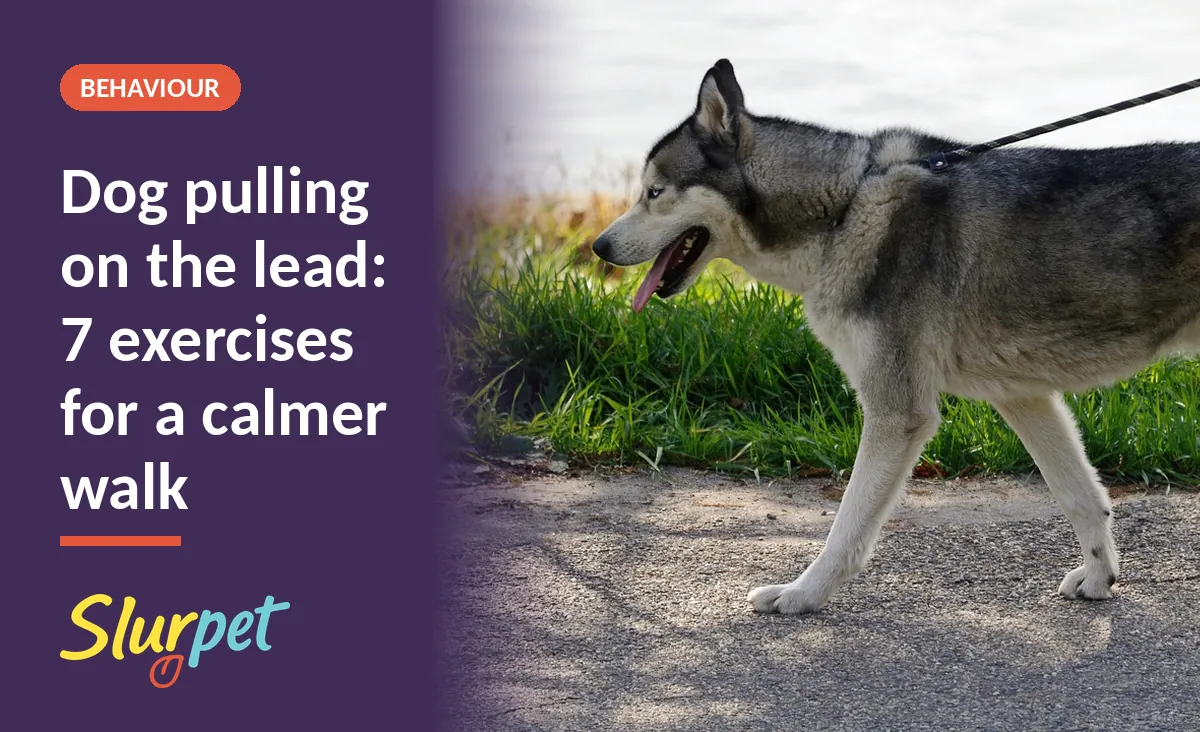
If your dog pulls on the lead, it isn’t being stubborn or “dominant”: it has simply learned that pulling gets it moving forward. The fix is to calmly teach the opposite: stop as soon as the lead goes tight and reward your dog when it stays loose. Here are 7 practical exercises, the best equipment and the mistakes to avoid.
At a glance
- Dogs pull because every time they do, they reach what they want sooner: a sniff, a greeting, something to explore.
- Every exercise follows the same principle: tight lead = we stop; loose lead = we move on and a reward arrives.
- Animal welfare organisations advise against choke, prong and shock collars: the AVSAB recommends reward-based methods only.
- In the UK, dogs must be on a lead on roads designated by the local authority; in Italy, the lead in built-up areas and public places can be no longer than 1.5 metres.
- It takes consistency and patience: walks will be slower at first, but progress does come.
Why does a dog pull on the lead?
A dog pulls because it works: if you follow every time the lead goes tight, it learns that pulling is the quickest way to reach the bush, the other dog or the park. As the UK charity PDSA explains, many dogs learn this as puppies, when a small tug was all it took to get what they wanted.
Add to that the excitement of going out, especially after hours indoors, and a world full of interesting smells. What has been learned can be unlearned: you don’t need strength, you need to make walking on a loose lead more rewarding for your dog than pulling.
Harness or collar: which is better for a dog that pulls?
For a dog that pulls, the best equipment is whatever causes no pain and is comfortable: a well-fitted harness or a flat collar, with a fixed lead of normal length. Tools that “correct” through pain should be avoided.
The PDSA recommends a harness if your dog pulls and advises against anything painful or that restricts movement, such as a choke collar. RSPCA Queensland recommends a front-attaching harness with a double-ended lead. The AVSAB, the American society of veterinary behaviourists, calls for avoiding choke, prong and shock collars: punishment-based methods harm the dog’s welfare and the human-animal bond, and are no more effective than reward-based ones.
So does a harness “teach” pulling? A study published in Frontiers in Veterinary Science in 2021 measured lead tension in 52 shelter dogs wearing a collar and a back-clip harness: to reach a food treat, the dogs pulled harder and for longer in the harness, while with a toy there was no difference. That doesn’t make harnesses wrong, but on its own a harness won’t solve the problem: training is still needed.
The lead matters too. Battersea, the well-known London rescue centre, recommends a standard lead of around 1.2 to 2 metres; in Italy the legal limit in built-up areas and public places is 1.5 metres, so if you travel there choose 1.2 to 1.5 metres. The RSPCA discourages extendable leads because they teach dogs to pull: the line only gets longer when the dog pulls.
How should you prepare before you start?
Before heading out, get small soft treats, a fixed lead and a dog that isn’t over-excited. A few simple steps make the exercises far more effective.
- Small, tasty treats. The RSPCA suggests small soft treats that your dog can eat in a second without being distracted by chewing. You can also use part of its daily kibble or break up some snacks for dogs.
- Count treats in the daily ration. AAHA guidelines suggest keeping snacks and treats to around 10% of daily calories: if you do a lot of training, take a little out of the bowl. Our guide How much should a dog eat? shows you how to work it out.
- Burn off some energy. PDSA and Battersea suggest a play session before training, especially for very lively dogs.
- Pick a side. Battersea advises choosing which side your dog walks on and sticking to it, so it knows where rewards appear.
- Short sessions. A few positive minutes beat half an hour of frustration, for both of you.
What are the 7 exercises to stop a dog pulling?
These 7 exercises are based on advice from Dogs Trust, PDSA, Battersea and the RSPCA and should be done in order, starting somewhere quiet. Only move on when your dog is doing well at the previous one.
1. The “traffic light”: tight lead, we stop
This is the basic exercise. As soon as the lead tightens, stop: stand still, stay quiet and don’t pull back. When your dog comes back towards you or eases the tension, even slightly, set off again. Dogs Trust puts it like this: stop the second the lead starts to tighten and don’t move forward again until it is slack. At first you’ll stop a lot: that’s normal.
2. Rewards by your leg
Teach your dog that the most “rewarding” spot is next to you. At home or in the garden, even off lead, reward it every time it is at your side. Deliver the treat level with your leg, not in front of you: according to Battersea, rewarding in front teaches the dog to get in your way. Over time, increase the number of steps between rewards.
3. The “with me” cue
Give walking by your side a name. Let your dog sniff a treat, bring your hand to your side, say “with me” and take one or two steps; if the lead stays loose, reward. Battersea suggests building up the steps gradually. Soon your dog will link the word to the position, and you can use it when you see a distraction coming.
4. Changes of direction
Walk in a straight line and, before your dog reaches the end of the lead, turn the other way in a cheerful voice, without jerking. When it catches up, reward. Dogs Trust recommends changing direction now and then: your dog learns to keep an eye on you because it doesn’t know where you’re going.
5. Changes of pace
Alternate slow, normal and slightly faster walking, rewarding your dog when it adjusts and stays beside you. Battersea places this among the final steps: it makes lead walking more flexible and interesting.
6. Sniff breaks with a release cue
Sniffing is a real need, not a whim. Choose a word such as “go sniff” or “off you go” and use it to give permission to explore a flower bed or a tree; then call your dog back with “with me” and walk on. Battersea recommends planned sniff breaks: your dog learns that exploring will come, but you decide when.
7. Distractions, one at a time
Only when your dog walks well at home and in the garden should you take the exercises to a quiet street, then busier areas. Dogs Trust advises going at your dog’s pace and dropping back a stage if it struggles. In a new, more stimulating place, shorten sessions and reward more often.
Puppy, adult or senior: what changes?
The method is the same at any age, but the timescale and focus change. Battersea notes that many puppies improve within a few weeks, while adult dogs that have pulled for a long time may take longer, and that setbacks during adolescence are normal.
| Stage or type of dog | What to expect | What to focus on |
|---|---|---|
| Puppy | Learns quickly but tires and gets distracted easily | Very short sessions, lots of rewards, getting used to harness and lead indoors first |
| Adolescent | Possible “setbacks” even after good progress | Go back to exercises 1 and 2, reduce distractions, stay consistent |
| Adult that has pulled for years | The habit is deep-rooted, it takes more weeks | Total consistency on every walk, high-value rewards, patience |
| Senior dog | Slower pace, less stamina | Adapt pace and routes; if the way it walks changes suddenly, see your vet |
| Large, strong dog | Can pull you off balance | Front-clip harness and very quiet places at first |
| Small dog | Pulling is often tolerated, but the neck is delicate | Same exercises, ideally with a well-fitted harness |
If you have a puppy, the Puppy dog category has food and snacks for its age that also work well as rewards.
Which mistakes should you avoid?
The most common mistake is inconsistency: if your dog sometimes gets ahead by pulling, it will keep trying. These are the mistakes flagged by UK and Australian welfare organisations.
- Jerking or pulling back on the lead. PDSA and Dogs Trust are clear: never pull back, wait for your dog to ease off.
- Telling off or punishing. Your dog won’t understand what you want, and walks become stressful.
- Only training now and then. “You need to train on every walk,” the PDSA reminds us: every outing where your dog pulls and moves forward strengthens the habit.
- Rewarding at the wrong moment. Battersea advises against feeding after your dog pulls away and comes back: reward loose-lead walking, not the return.
- Stopping treats abruptly. Phase them out slowly, replacing them with praise and the freedom to sniff.
- Starting in the hardest place. A busy street is not where to begin.
How can you tell you’re making progress?
You’re making progress if the number of steps between rewards goes up, you stop less often and your dog comes back towards you on its own when the lead tightens. Dogs Trust warns that walks will take longer while your dog is learning: allow for it.
Ask a qualified trainer who uses kind methods for help if your dog keeps pulling despite consistent training, grabs or bites the lead, or seems worried about going out: these are the signs Battersea highlights. See your vet instead if the change is sudden, or if your dog limps, coughs after pulling or seems to be in pain: sometimes a new behaviour has a physical cause.
What does the law say about leads in the UK and Italy?
In the UK, section 27 of the Road Traffic Act 1988 makes it an offence to have a dog on a road designated by the local authority without holding it on a lead, and rule 56 of the Highway Code says to keep your dog on a short lead when walking on the pavement, road or paths shared with cyclists or horse riders. The Highway Code is guidance, while local rules can add further requirements.
If you travel to Italy with your dog, Italian law applies: in built-up areas and places open to the public, the lead must be no longer than 1.5 metres, except in dog areas designated by local councils. This comes from the Italian Ministry of Health ordinance of 6 August 2013 on protection from dog attacks, renewed every year: the latest extension, dated 16 July 2026, keeps it in force until September 2027.
The same ordinance makes the owner always responsible for the dog’s welfare, control and handling, and liable under civil and criminal law for any harm caused. Anyone who agrees to look after someone else’s dog takes on that responsibility for the period. You must also carry a muzzle, rigid or soft, to use if there is a risk to people or animals or if the authorities ask, and in towns you must pick up after your dog and carry the means to do so. For other Italian obligations, see our article on microchipping and the SINAC register.
What about other countries?
In many European countries, lead rules are set regionally or locally rather than nationally, so check the rules for your destination before you travel.
- Germany: when a dog must be on a lead is decided by each federal state, through state dog laws, dog regulations or local rules; there is no general duty to keep dogs on a lead at all times. Many states impose a seasonal lead requirement in woods and fields during the breeding season, generally from 15 March to 15 July (from 1 March in some).
- Austria: lead or muzzle requirements are set by municipalities or by state law, so they vary from place to place; they often cover residential areas, green spaces and public transport.
- France: category 1 and 2 dogs must be kept on a lead and muzzled on public roads; for category 2, owners also need liability insurance and a training course.
Checklist for tomorrow’s walk
- Comfortable harness or flat collar, well fitted.
- Fixed lead between 1.2 and 1.5 metres (no extendable lead in town).
- Small soft treats in a pouch within easy reach.
- Poo bags, plus a muzzle where required.
- Five minutes of play before you leave.
- A short, quiet route to practise on.
- The traffic-light rule, applied every single time.
Frequently asked questions
How long does it take for a dog to stop pulling?
It depends on age, personality and how ingrained the habit is. Battersea notes that many puppies improve within a few weeks, while adults that have pulled for a long time may need more. Consistency on every walk makes the difference.
Does a harness make a dog pull more?
A 2021 study found that, to reach food, dogs pulled harder in a back-clip harness than in a collar. Many organisations still recommend harnesses because they don’t press on the neck: use one alongside training, not instead of it.
Can I use an extendable lead?
Check local rules first; in Italy, for example, the lead must not exceed 1.5 metres in built-up areas. The RSPCA also discourages extendable leads because dogs learn that pulling gets them more space.
Do I have to reward every step forever?
No. Rewards are frequent at first, then gradually become less frequent, as the PDSA recommends, and are replaced by praise, a fuss and permission to sniff.
This article is for information only and does not replace the advice of your vet or a qualified dog trainer. If your dog’s behaviour changes suddenly or you notice signs of pain, contact your vet.
Slurpet products for lead training
For these exercises you mainly need small, tasty rewards, counted within the daily ration: here are a few ideas from our range.
- Monge Gift Sticks Training Fresh Duck and Spirulina 45 g: sticks designed for training adult dogs, easy to break into lots of small rewards.
- Purina Adventuros Nuggets with wild boar flavour 90 g: small bites, handy to keep in your treat pouch on walks.
- Monge Gift Sticks Puppy and Junior 45 g: for puppies just learning to walk on a lead.
- Primordial dry dog food adult all breeds with deer and turkey 2 kg: a complete dry food for adult dogs of all sizes; part of the daily ration can become your training reward, with no extra calories.
You’ll find more ideas among our snacks for dogs and in the Puppy dog category. If your dog is very excitable in other situations too, the Behavior and stress category has products to discuss with your vet.
Sources
- Gazzetta Ufficiale, Ordinance of 10 July 2025 extending the ordinance of 6 August 2013 (GU no. 192, 20/8/2025)
- Certifico, Ordinanza 6 agosto 2013 – text (GU no. 209, 6/9/2013)
- Vet33 (2026), Aggressioni canine, prorogata l’ordinanza: le regole restano in vigore fino al 2027
- Shih H.Y. et al. (2021), Dog Pulling on the Leash: Effects of Restraint by a Neck Collar vs. a Chest Harness, Frontiers in Veterinary Science 8:735680
- AVSAB (2021), Position Statement on Humane Dog Training
- Dogs Trust, How to stop your dog pulling on the lead
- PDSA, How to train your dog not to pull on the lead
- Battersea, How to teach your dog to walk on a lead
- RSPCA Queensland, How to stop your dog pulling the lead
- AAHA (2021), Nutrition and Weight Management Guidelines – Feeding plans
- legislation.gov.uk, Road Traffic Act 1988, section 27
- GOV.UK, The Highway Code – Rules about animals (47 to 58)
- ZDFheute, Leinenpflicht für Hunde in Deutschland
- oesterreich.gv.at, Maulkorb- und Leinenzwang
- Service-Public.fr, Avoir un chien de catégorie : quelles sont les règles ?