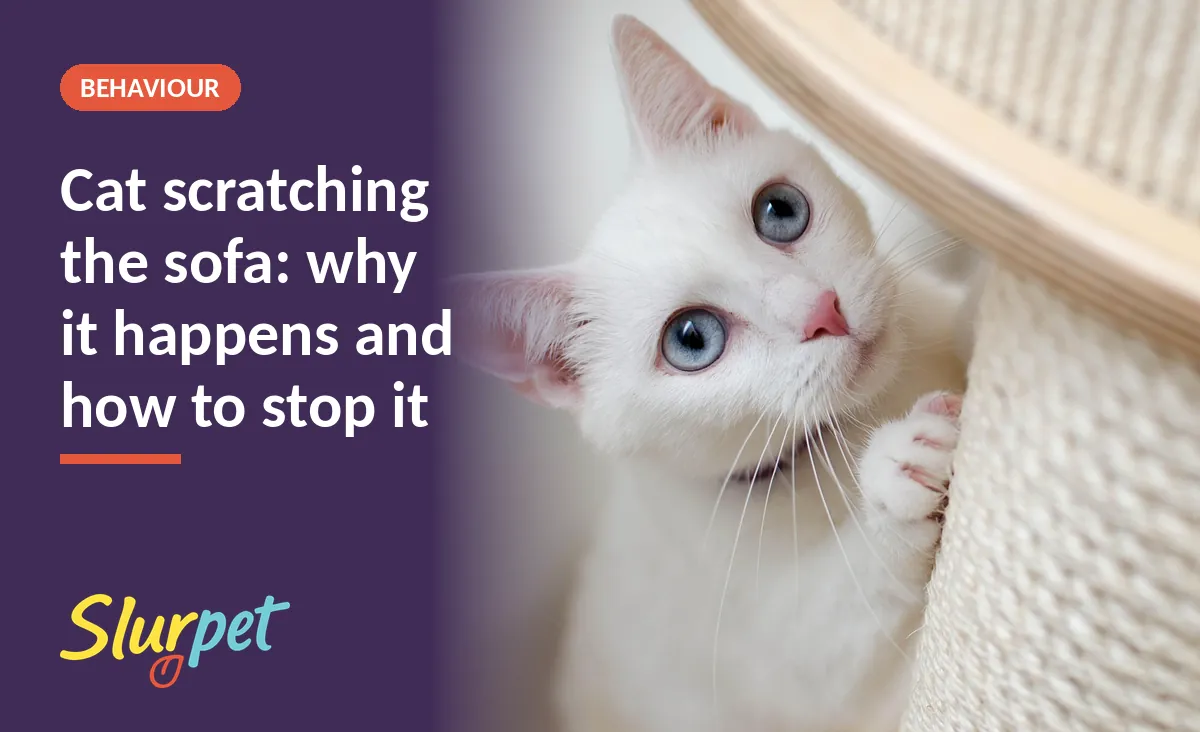
Your cat scratches the sofa because scratching is a natural need: it keeps the claws in shape, leaves their scent behind and gives them a good stretch. You can’t stop it, but you can redirect it. With a sturdy, tall scratching post placed right in front of the damaged spot, rewards at the right moment and no punishment, most cats change their habits.
At a glance
- Scratching is normal and useful: cats renew their claws, mark territory with the scent from their paws and stretch.
- The sofa appeals because it’s stable, sits in the middle of the home and has a fabric that claws grip well.
- The answer is a better alternative: a sturdy, tall enough scratching post right next to the favourite spot, then moved gradually.
- Punishment doesn’t work: it only teaches your cat to be afraid of you.
- In the UK, a procedure such as declawing that interferes with sensitive tissue or bone for non-medical reasons is an offence under the Animal Welfare Act 2006.
Why does my cat scratch the sofa?
Cats scratch because it’s an innate behaviour with several functions, not spite. A 2019 review in the Journal of Feline Medicine and Surgery calls it a “normal, beneficial behavior” and notes that damaged furniture is one of the reasons some cats are given up: understanding it is the first step to living together happily.
Scratching has four main functions:
- Claw care: scratching removes the worn outer sheath of the claw and keeps it in good condition.
- Scent marking: glands between the paw pads release scent. Every scratch leaves a chemical message saying “this place is mine”.
- Visual marking: the marks left on fabric or wood are also a clearly visible signal.
- Stretching: reaching up high, the cat stretches its back, shoulders and legs.
According to the Cornell Feline Health Center, scratching is largely a marking behaviour. That’s why cats don’t pick a spot at random: they prefer places that matter to them, such as the sofa where the family sits, the front door or the area near where they sleep.
Why the sofa and not the scratching post?
The sofa is heavy, tall enough to stretch against, has a fabric the claws can grip and sits at the heart of family life. The scratching post, on the other hand, is often short, wobbly or tucked into a corner the cat never visits: your cat isn’t “misbehaving”, it’s simply choosing the best option it has.
How does the need to scratch change with age?
Cats need to scratch throughout their lives, but the need changes with age. In an international survey of 4,331 cat owners in 39 countries, published in 2016 in the Journal of Feline Medicine and Surgery (Wilson and colleagues), “inappropriate” scratching of furniture and household items decreased as cats got older. The same study found no difference between neutered and entire cats, male or female.
| Life stage | What happens | What to do |
|---|---|---|
| Kitten | Explores, plays and learns where to scratch: the best time to build the habit. | Provide one or more scratching posts straight away and reward every use. |
| Adult cat | Scratching is mostly marking and claw care; every cat has clear preferences for material and direction. | Watch what it chooses (vertical or horizontal, fabric, rope, cardboard) and offer something similar. |
| Older cat | In the Wilson study, cats aged 10 to 14 preferred carpet, while rope was the favourite surface at every other age. | Add horizontal or gently sloping, easy-to-use surfaces, and talk to your vet if your cat stops scratching or seems stiff. |
How do I choose the right scratching post?
The right scratching post is stable, tall enough for your cat to stretch out fully and covered in a material it likes. The Cornell Feline Health Center recommends a post sturdy enough not to topple over and at least as tall as your cat standing on its hind legs with its front legs outstretched. If the post wobbles the first time your cat leans on it, it probably won’t use it again.
The Wilson study offers some practical pointers:
- rope (such as sisal) was the material used most often when it was offered, even though carpet was the most common covering in homes;
- cats used their preferred material more when the post was a simple upright post or a cat tree with at least two levels and at least 3 ft (about 90 cm) tall;
- furniture scratching was less common in homes with several different types of scratching post.
Preferences are individual, though: some cats scratch vertically, others horizontally, for example on a rug or on corrugated cardboard. The Feline Veterinary Medical Association (AAFP) suggests trying several materials: sisal rope, rough fabric, cardboard or wood. And, as Cornell advises, don’t throw the post away when it’s worn: to your cat, that’s exactly the “right” one.
Where should I put the scratching post?
The scratching post belongs where your cat wants to scratch, not where it bothers us least. Vets agree: at first, place it right in front of or next to the spot on the sofa your cat uses. Once it’s using the post regularly, you can move it a few centimetres at a time to where you’d prefer it.
Other good spots are near where your cat sleeps and the main living areas. If your cat scratches in several rooms, you’ll need more than one post.
How do I stop my cat scratching the sofa?
Make the scratching post more interesting than the sofa, and the sofa less appealing for a while. Here are the steps, in order:
- Watch how your cat scratches: vertically on the arm or horizontally on the seat? On smooth or rough fabric? Choose a post with similar features.
- Put the post in front of the damaged spot, so it’s the first thing your cat finds.
- Make the sofa less inviting: Cornell suggests temporarily covering the area with a blanket, a plastic sheet or double-sided tape.
- Clean marked areas with soap and water or an odour neutraliser, because the cat’s own scent draws it back to the same spot.
- Reward immediately when your cat uses the post, with a stroke, a kind word or a small treat. Remember to take treats out of the daily allowance: our guide How much should a cat eat? explains how to work it out.
- Make the post fun: play with a feather wand next to it, hang a toy from it, or choose one with a hideaway or a top platform.
- Trim the claws regularly, if your cat allows it: shorter claws do less damage while it learns the new habit.
There are also products with a synthetic pheromone that mimics the scent released by the paws, to be applied to the scratching post. A 2021 review in Veterinary Evidence found “weak” evidence that they help alongside a scratching post: an extra aid, not the solution. Be careful with “calming” pheromone sprays, though: the Feline Veterinary Medical Association says not to spray them on the scratching post, but on the areas you want to protect, after cleaning them.
What mistakes should I avoid?
The most common mistake is punishing your cat. Telling it off, squirting water or making loud noises won’t teach it to use the post: according to the Cornell Feline Health Center, punishment only teaches your cat to fear you.
Other common mistakes:
- buying a short or lightweight post that topples over;
- putting it in a hidden corner, far from the spots your cat has chosen;
- offering only one type of surface to a cat that scratches both vertically and horizontally;
- removing the sofa covers too soon;
- expecting results within a few days: it takes consistency and patience.
Are nail caps and claw trimming a solution?
Nail caps help, but they aren’t a permanent fix. They’re small plastic caps glued over the claws: Cornell lists them as an option for cats that let you handle their paws, noting that they need replacing periodically as the claw grows. Your cat will still need to scratch, so the scratching post remains essential.
Regular claw trimming reduces damage; according to the Feline Veterinary Medical Association, indoor cats, kittens and older cats need it more often. If you’re unsure how to do it, ask your vet to show you the right spot: the pink part of the claw contains blood vessels and nerves.
Do cats scratch more when stressed?
Yes, it can happen: anxious or frightened cats may scratch more. A house move, a new pet or a change in routine can increase scratching, even in a cat that used to use its post well (we also covered this in how dogs and cats cope when the clocks go back).
A predictable routine, daily play, high perches to watch the home from and quiet hiding places all help. There are also supplements for behaviour and stress, always to be considered together with your vet. If scratching appears suddenly alongside other signs, such as weeing outside the litter tray, aggression or changes in appetite, talk to your vet.
Is declawing allowed?
No: in the UK, declawing for convenience is not allowed. The Animal Welfare Act 2006 (section 5) makes it an offence to carry out a procedure that interferes with an animal’s sensitive tissues or bone structure other than for the purpose of its medical treatment. Declawing falls into this category because, as the Cornell Feline Health Center explains, it is an amputation of the bones at the tips of the toes.
Cornell also points out that declawing does not take away a cat’s desire to scratch. A good scratching post, patience and positive reinforcement remain the kind, effective way forward.
What about other countries?
Declawing for convenience is widely banned across Europe, in different ways:
- Italy: under Italian law, the European Convention for the Protection of Pet Animals (Strasbourg, 1987), ratified by Italy with Law no. 201 of 4 November 2010, applies. Article 10 prohibits surgical operations for non-curative purposes and specifically names declawing and defanging; exceptions are allowed only for veterinary reasons or in the interest of the individual animal.
- Germany: the Animal Welfare Act (Tierschutzgesetz, § 6) generally prohibits amputating body parts of vertebrates, unless a vet considers it necessary in the individual case.
- Switzerland: the Federal Food Safety and Veterinary Office (FSVO/BLV) lists amputating cats’ claws and pulling their teeth among prohibited acts, and recommends providing suitable scratching surfaces.
- Spain: Animal Welfare Law 7/2023 (art. 27) bans all mutilation of pets, except for therapeutic need certified by a vet; functional or aesthetic reasons are not accepted.
How can I tell if it’s working?
It’s working when your cat goes to the post of its own accord and new marks on the sofa become rarer. A post that starts to fray is good news too: it has become your cat’s marking spot.
Checklist for the first few weeks:
- post stable and close to the damaged spot;
- a reward every time it’s used;
- sofa area covered and cleaned of scent;
- a horizontal alternative, if your cat also scratches rugs or seats;
- a few minutes of active play every day.
If you see no improvement after a few weeks, or if scratching suddenly increases, ask your vet for advice; they can also refer you to a vet who specialises in behaviour.
Frequently asked questions
Is my cat scratching the sofa out of spite?
No, cats don’t scratch out of spite. Scratching is a natural need linked to claw care, territory marking and stretching: if your cat chooses the sofa, it’s because, from its point of view, it’s the best surface available.
How long does it take to get a cat used to a scratching post?
It depends on the cat and how long it has been using the sofa: it usually takes a few weeks of consistency. Keep the sofa covered and reward every use of the post until the new habit is settled.
Vertical or horizontal scratching post?
It depends on your cat’s preferences: watch whether it goes for arms and backs or rugs and seats. If in doubt, offer both, because having several types of scratching post at home is linked to less furniture damage.
Should I train a kitten straight away?
Yes, it’s the best time. Provide a scratching post from day one, show it to your kitten during play and reward it when it’s used: a habit learned early is much easier to keep.
Do neutered cats scratch less?
Not necessarily. In the study by Wilson and colleagues, neutered and entire cats were equally likely to scratch in the wrong places: neutering is no substitute for a scratching post.
This article is for information only and does not replace your vet’s advice: if your cat’s behaviour changes suddenly or worries you, get in touch with them.
Slurpet products to reward your cat
Positive reinforcement is at the heart of scratching post training: a small reward at the right moment is worth more than a hundred tellings-off.
- Purina Felix Party Mix cat snack Original Mix 60 g: small, crunchy treats, handy to keep in your pocket to reward your cat the moment it uses the post.
- Monge cat snack Gift Soft Sticks Hairball salmon and artichoke 15 g: soft sticks you can break into small pieces, suited to adult cats that prefer tender rewards.
- Primordial dry adult sterilized cat with turkey and herring 400 g: dry food for neutered adult cats; you can use a few kibbles from the daily ration as rewards or in foraging games, without adding calories.
You’ll find more in the Snacks for cats and Support for sterilized cats categories, and in the For your cat section.
Sources
- Cornell Feline Health Center – Feline Behavior Problems: Destructive Behavior
- Wilson C. et al., Owner observations regarding cat scratching behavior: an internet-based survey, Journal of Feline Medicine and Surgery, 2016
- DePorter T.L., Elzerman A.L., Common feline problem behaviors: Destructive scratching, Journal of Feline Medicine and Surgery, 2019 (PubMed)
- Goins M., Use of the feline interdigital semiochemical (FIS) to redirect unwanted scratching behaviour in cats, Veterinary Evidence, 2021
- Feline Veterinary Medical Association (AAFP) – Alternatives to Declawing
- VCA Animal Hospitals – Why cats scratch furniture (and how to stop it!)
- Animal Welfare Act 2006, section 5 – legislation.gov.uk
- Italian Law no. 201 of 4 November 2010 – ratification of the European Convention for the Protection of Pet Animals (text on ANMVI Oggi)
- Tierschutzgesetz § 6 – gesetze-im-internet.de
- FSVO/BLV – Katzen (Switzerland)
- Ley 7/2023 de protección de los derechos y el bienestar de los animales – BOE