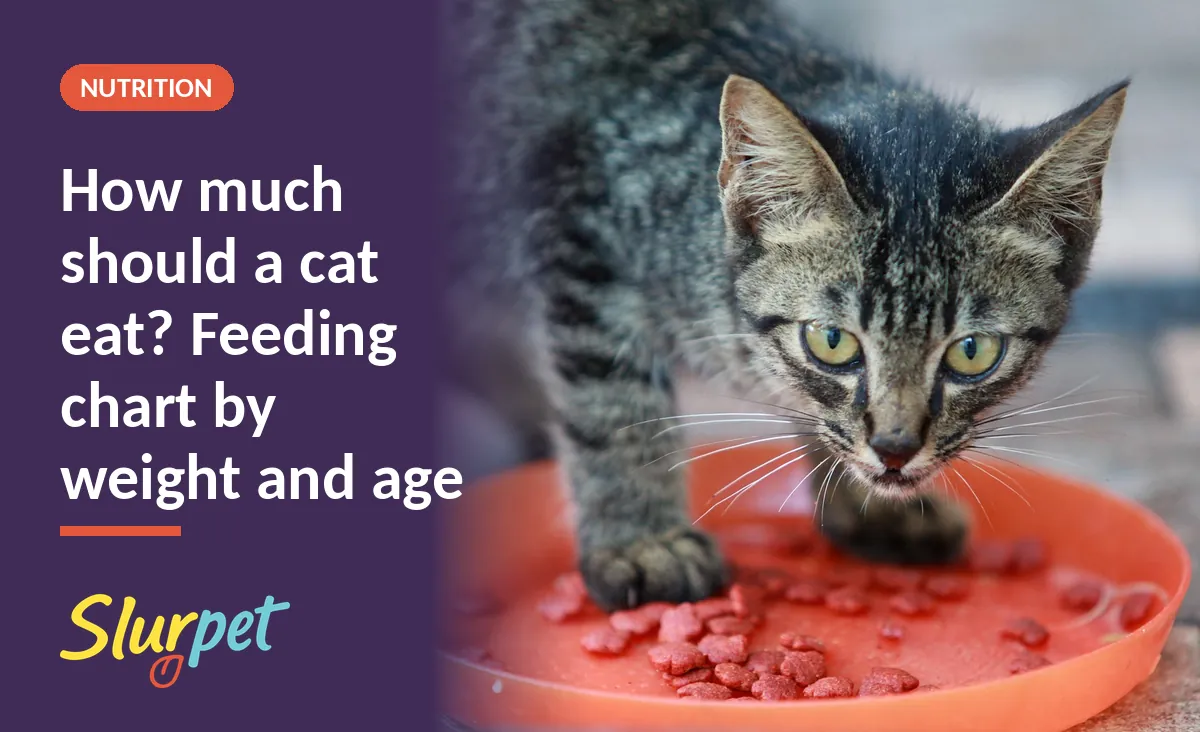
A fit adult cat of about 4 kg needs on average 200-280 kcal a day, which is roughly 50-75 g of dry food or 235-325 g of wet food, depending on the product. The right amount, however, depends on ideal weight, age, neutering and activity: below you will find the charts and the method to work it out.
In short
- Start from the energy requirement in kcal, not from grams: grams change from one food to another.
- A neutered adult cat of 4 kg starts at about 240 kcal a day; if it tends to gain weight, at about 200.
- Growing kittens need about 2.5 times their resting energy requirement: the portion has to be recalculated often.
- Split the daily portion into several small meals and weigh it on a kitchen scale; keep treats within 10% of calories.
- Charts and labels are only a starting point: weight and body shape tell you whether the amount is right.
What determines how much a cat should eat?
Mainly ideal weight, age, activity and whether the cat is neutered: two cats of the same weight can have very different needs.
Needs are measured in kilocalories (kcal). Vets start from the resting energy requirement, or RER, and multiply it by a factor that reflects the cat’s life stage. The MSD Veterinary Manual (known in North America as the Merck Veterinary Manual) gives the formula RER = 70 × (body weight in kg)0.75 and these guide factors for cats: 1.2 for a neutered adult, 1.4 for an intact adult, 1.0 for an obesity-prone cat and 2.5 for a growing kitten.
The same manual points out that any individual animal may need up to 30% more or fewer calories than the calculation suggests. That is why the figures below are a starting point to check against the scales, not a fixed rule. The WSAVA, the World Small Animal Veterinary Association, also presents its charts as guidance only: every cat is an individual.
These are the factors that matter most:
- Ideal weight: if your cat is overweight, the calculation is based on the weight it should be, not on its current weight.
- Age: kittens grow and burn a lot of energy per kilo; adults settle down; older cats should be assessed case by case.
- Neutering: after the operation energy needs drop and appetite tends to rise.
- Lifestyle: an indoor cat that sleeps a lot burns less than one that goes out and hunts.
- Type of food: dry and wet foods have very different energy densities.
How many calories does an adult cat need? Chart by weight
A fit neutered adult cat needs on average between 140 kcal a day (2 kg) and 360 kcal a day (7 kg): the chart below shows the values for each weight band.
Values are calculated with the formula and factors from the MSD Veterinary Manual and rounded to the nearest 5 kcal. Always use your cat’s ideal weight.
| Ideal weight | Obesity-prone (kcal/day) | Neutered adult (kcal/day) | Intact adult (kcal/day) |
|---|---|---|---|
| 2 kg | 120 | 140 | 165 |
| 2.5 kg | 140 | 165 | 195 |
| 3 kg | 160 | 190 | 225 |
| 3.5 kg | 180 | 215 | 250 |
| 4 kg | 200 | 240 | 275 |
| 4.5 kg | 215 | 260 | 305 |
| 5 kg | 235 | 280 | 330 |
| 5.5 kg | 250 | 300 | 350 |
| 6 kg | 270 | 320 | 375 |
| 7 kg | 300 | 360 | 420 |
A useful cross-check: in its chart for healthy adult cats in ideal body condition, the WSAVA gives a starting point of about 225-250 kcal a day for a 4 kg cat, in line with the middle column. Very sedentary indoor cats may need even less: we cover this in our guide on neutered cats and weight gain.
How many grams of dry or wet food a day?
To turn kcal into grams you need to know how many kcal your food contains: divide the daily requirement by the kcal per gram stated by the manufacturer.
Many manufacturers state energy in kcal per 100 g or per kg on the pack or on their website. If you cannot find it, ask the brand’s customer service; our guide on how to read pet food labels helps you find your way around the label. The gap between dry and wet food is large because wet food contains a lot of water: according to the MSD Veterinary Manual, canned food contains from 60% to more than 87% water, dry food from 3% to 11%.
The chart uses two example values, chosen only to show the calculation: dry food with 380 kcal per 100 g and wet food with 85 kcal per 100 g. With your own food the grams will be different.
| Ideal weight (neutered adult) | kcal/day | Dry food only (example 380 kcal/100 g) | Wet food only (example 85 kcal/100 g) | Mixed: 1 pouch of 85 g + dry food |
|---|---|---|---|---|
| 3 kg | 190 | about 50 g | about 225 g | pouch + about 31 g |
| 4 kg | 240 | about 63 g | about 280 g | pouch + about 44 g |
| 5 kg | 280 | about 74 g | about 330 g | pouch + about 55 g |
| 6 kg | 320 | about 85 g | about 380 g | pouch + about 66 g |
A step-by-step example
- Your cat is neutered and your vet tells you its ideal weight is 4 kg: the chart gives a starting point of about 240 kcal a day.
- You feed one 85 g pouch of wet food with 85 kcal per 100 g: that is about 72 kcal.
- That leaves about 166 kcal to cover with dry food.
- If the kibble has 380 kcal per 100 g, you need about 44 g (166 ÷ 3.8).
- Weigh out the 44 g on the scale and split it into several portions over the day.
If you want to understand when wet food makes sense and when kibble does, you will find pros and cons in our guide Dry or wet food for cats?.
How much should a kitten eat? Chart for kittens
A growing kitten needs much more energy per kilo than an adult: the MSD Veterinary Manual gives about 2.5 times the resting requirement, calculated on the kitten’s current weight.
The calculation therefore needs to be redone often, because weight changes from week to week. The MSD manual adds that kittens can also be fed free choice (with food always available) while they grow. The Cornell Feline Health Center points out that kittens need more food per pound of body weight than adults and should therefore be fed more often during the day.
| Kitten current weight | kcal/day (2.5 × RER) | Kitten kibble (example 400 kcal/100 g) |
|---|---|---|
| 0.5 kg | about 105 | about 26 g |
| 1 kg | about 175 | about 44 g |
| 1.5 kg | about 235 | about 59 g |
| 2 kg | about 295 | about 74 g |
| 2.5 kg | about 350 | about 87 g |
Here too the 400 kcal per 100 g kibble is just an example: check the value of your kitten food. Towards the end of growth the requirement per kilo falls and the portion moves closer to an adult’s: a good moment to review things with your vet, especially if the kitten is being neutered. Foods formulated for growth are in our kitten food category.
How does the portion change with age?
It changes mostly in the first year and after neutering; for senior cats there is no one-size-fits-all rule and it is best to decide with your vet.
The 2021 AAHA/AAFP Feline Life Stage Guidelines divide a cat’s life into: kitten (up to 1 year), young adult (1-6 years), mature adult (7-10 years) and senior (10 years and older). The table sums up what to watch at mealtimes in each stage.
| Life stage | Age | At mealtimes | Meals a day (Cornell guidance) |
|---|---|---|---|
| Kitten | 0-1 year | Growth food, about 2.5 × RER on current weight; portion recalculated often | 3 up to 6 months; 2 between 6 and 12 months |
| Young adult | 1-6 years | Stable requirement; reduce the portion after neutering | 1-2 (several small meals are better, see below) |
| Mature adult | 7-10 years | Watch the weight: cats often become less active | 1-2 or several small meals |
| Senior | 10 years and older | Same routine unless your vet advises otherwise; check weight more often | as before, unless advised otherwise |
On senior cats the Cornell Feline Health Center is clear: senior cats should keep the same feeding regimen unless the vet advises otherwise, and your vet can help you choose a food with the right amount of calories. The MSD Veterinary Manual notes that neither AAFCO nor the NRC currently recognises different nutritional requirements for healthy older cats, so senior foods do not follow a single standard. Unwanted weight loss in an older cat should not be fixed by simply filling the bowl: it is a reason for a vet visit.
How many times a day should a cat eat?
Several small meals are better than one or two large ones: that is how cats eat in nature.
According to the MSD Veterinary Manual, cats graze, eating as many as 18 small meals a day. The AAFP consensus statement on feeding cats (Sadek and colleagues, 2018) recommends splitting the daily food allowance into multiple small meals spread over 24 hours, using puzzle feeders when possible: toys that release food a little at a time. Cornell describes one or two meals a day as appropriate for most adult cats: if you go that way, keep the total amount fixed.
A bowl that is always full of kibble (free feeding) may suit some cats, but according to Cornell it leads others to overeat and gain weight. If your cat is a foodie, measure out the day’s portion in the morning and hand it out yourself.
Practical ideas for mealtimes
- Put the day’s kibble in a container in the morning: when it is empty, the portion is finished.
- Use a puzzle feeder or hide a few pieces of kibble around the home so your cat can “hunt”.
- An automatic feeder with a timer helps if you are out for many hours.
- With more than one cat, set up separate feeding stations out of sight of each other and away from the litter tray, as the AAFP recommends.
How can you tell if the amount is right?
The amount is right if your cat keeps a stable weight and good body shape: the scales and your hands matter more than any chart.
- Weigh your cat regularly: step on the scales holding your cat and subtract your own weight. Write it down.
- Feel the ribs: in a fit cat they are easy to feel under a thin layer of fat, without sticking out.
- Look from above: behind the ribs there should be a hint of a waist.
- Adjust in small steps: if the weight goes up, reduce the portion a little and check again after a few weeks.
- Ask your vet to assess body condition at check-ups: they use a points scale and can tell you your cat’s ideal weight.
Regular monitoring of weight and body condition is recommended by the AAFP, especially in older cats or cats with chronic illness. Cornell defines obesity as body weight 20% or more above normal: for a 4 kg cat that is just 800 grams extra.
What are the most common mistakes?
The most common mistake is guessing: a scoop or a handful can vary by several grams, and on a 4 kg animal that makes a difference.
- Calculating on the current weight of a cat that is already overweight: use the ideal weight.
- Adding up wet and dry food at the full amounts on the labels: in mixed feeding each food covers only part of the kcal.
- Forgetting treats: the AAHA guidelines say treats and other foods should make up no more than 10% of daily calories.
- Not updating the portion after neutering, a change of food or a change of lifestyle.
- Giving table scraps: besides the calories, some foods are dangerous (see foods toxic to dogs and cats).
- Putting an overweight cat on a crash diet: weight loss should be planned with your vet and must be gradual.
Your cat has gained or lost weight: what should you do?
In both cases the first step is a vet visit: the vet checks for medical causes and sets a plan with realistic goals.
If your cat needs to lose weight, it should happen slowly: Cornell talks about roughly 1-2% of body weight per week. Do not leave your cat without food and do not cut portions drastically on your own. For cats that tend to put on weight there are reduced-calorie foods in our weight control support for cats category, to be chosen together with your vet when a proper weight-loss plan is needed.
If, on the other hand, your cat loses weight although you have not changed anything, eats less than usual, or eats a lot but gets thinner, do not simply fill the bowl: these are signs for your vet to assess.
Frequently asked questions
How many grams of dry food should a 4 kg cat eat?
It depends on the kcal in the food. With kibble at 380 kcal per 100 g, a fit neutered 4 kg cat starts at about 60-65 g a day; if it tends to gain weight, at about 50-55 g. Always check your product’s label and track the weight over time.
How many pouches of wet food a day for a cat?
With wet food at about 85 kcal per 100 g, a neutered 4 kg cat would need about 280 g a day, a little more than three 85 g pouches if it eats only wet food. Calories vary a lot between products, so check the label.
Can I leave kibble out all the time?
It works for some cats, but for many it leads to overeating and weight gain, as Cornell points out. A middle way is to weigh the day’s portion in the morning and hand it out at different times.
My cat always asks for food: should I give more?
Not necessarily: many cats ask for food even when the portion is correct, out of habit or for attention. If the weight is stable, try splitting the same amount into more small meals or using a puzzle feeder; if the weight drops, talk to your vet.
Is the amount on the label reliable?
It is a good starting point worked out by the manufacturer for an average cat. Your cat may need more or less: confirmation comes from weight and body shape after a few weeks.
This article is for information only and does not replace the advice of your vet.
Slurpet products for feeding your cat at every age
A few foods from our range, to be portioned with the method described in this guide.
- Primordial Kitten grain free with duck and turkey: grain-free dry food for growing kittens: work out the portion on their current weight and update it every couple of weeks, as explained above.
- Purina Adult Sterilised Maintenance with chicken and beef: wet food in 85 g pouches for neutered adult cats, handy for the mixed feeding example: one pouch a day plus weighed kibble.
- Purina Pro Plan Sterilised Senior 7+ Maintenance with turkey: wet food for neutered cats aged 7 and over, for cats entering the mature adult stage and owners who want to add water to the diet.
- Royal Canin Light Weight Care in sauce: wet food for adult cats that tend to put on weight, to be fed within the daily portion and with regular weigh-ins.
Browse the full selection in kitten food, adult cat food and weight control support for cats.
Read also: Neutered cat: how feeding changes and how to prevent weight gain · Dry or wet food for cats? Pros, cons and how to combine them
Sources
- MSD/Merck Veterinary Manual, Nutritional Requirements of Small Animals
- WSAVA, Calorie Needs for Healthy Adult Cats (2020)
- WSAVA, Global Nutrition Guidelines and toolkit
- AAHA, 2021 Nutrition and Weight Management Guidelines – Feeding plans for healthy, appropriate-weight cats and dogs
- AAHA/AAFP, 2021 Feline Life Stage Guidelines
- Sadek T. et al., Feline feeding programs: addressing behavioural needs to improve feline health and wellbeing, J Feline Med Surg, 2018
- Cornell Feline Health Center, How often should you feed your cat?
- Cornell Feline Health Center, Feeding your cat
- Cornell Feline Health Center, Obesity
- Cornell Feline Health Center, Loving care for older cats