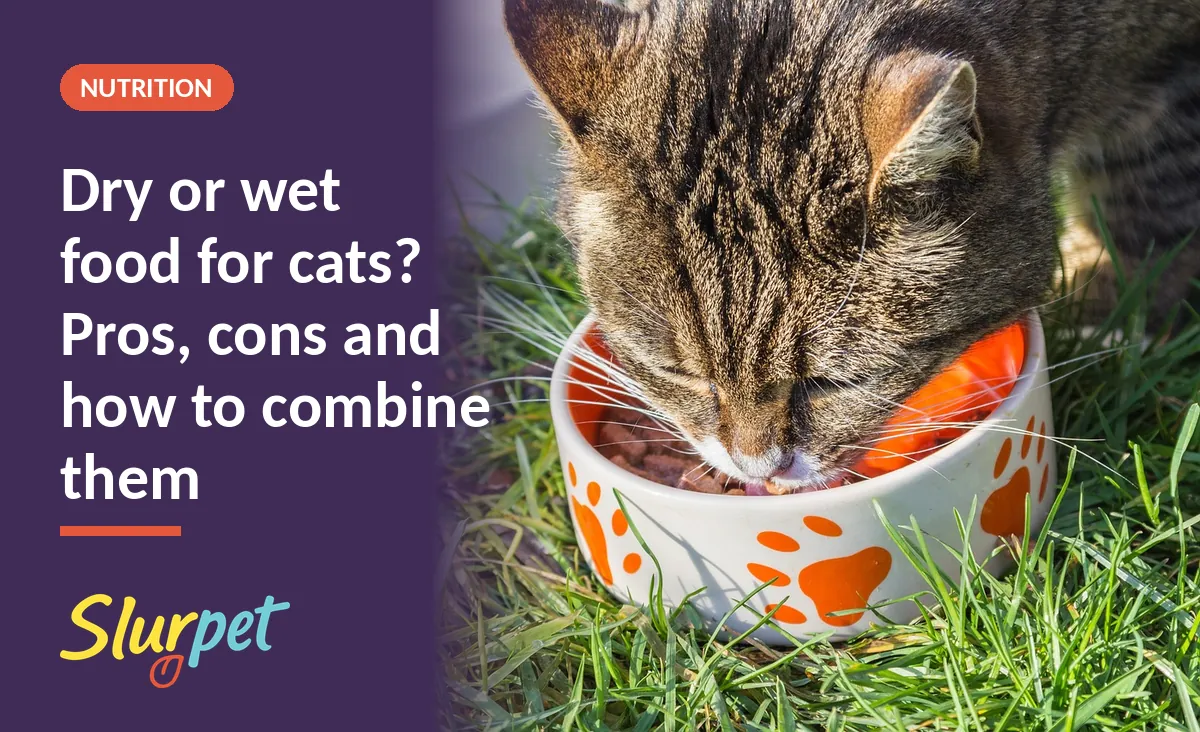
Dry or wet food for your cat? There is no single answer for every cat: both can be complete, balanced foods. Wet food provides a lot of water and fewer calories per gram, which helps the kidneys, the urinary tract and weight control. Dry food is practical, keeps for a long time and works well with food puzzles. For many cats, the best solution is a combination of the two.
In short
- Wet food is about 70–80% water; dry food contains less than 10%.
- Gram for gram, dry food has 3 to 4 times more calories than wet food.
- More water in the diet means more diluted urine, which supports the urinary tract.
- Mixed feeding works well, as long as total daily calories stay under control.
- Always check the label: is the product a “complete” or a “complementary” food?
What is the difference between dry and wet cat food?
The main difference is water. Wet food in pouches, cans or trays usually contains 70–80% water, while dry food contains less than 10%. This changes the energy density: according to International Cat Care, wet food provides about 0.8–1.5 kcal per gram, while dry food reaches 3–4 kcal per gram or more.
This does not make one format nutritionally better than the other. If the label says “complete feed”, the product covers all of your cat’s needs on its own, whether dry or wet. Many pouches, however, are “complementary feeds”: they must be combined with a complete food and cannot be the only thing your cat eats. This labelling is required across the EU by Regulation (EC) No 767/2009, and the same rules apply in the UK.
What are the benefits of wet food?
The first benefit is hydration. Cats descend from desert hunters and tend to drink little, because in the wild they get most of their water from prey. A study published in the British Journal of Nutrition (Buckley and colleagues, 2011) compared diets with different moisture levels: on the diet with 73% moisture, cats produced more urine, with a lower specific gravity (1.036 versus 1.052–1.054) and a lower risk of calcium oxalate crystal formation.
Other benefits:
- Weight control: for the same volume in the bowl, wet food provides fewer calories and is more filling.
- Palatability: it is often preferred, which helps with older or fussy cats.
- Constipation: the extra water supports regular digestion.
The downsides are a higher cost per portion and storage: once opened, it must be covered and kept in the fridge, and used within the time stated on the pack. Do not leave it in the bowl for hours.
What are the benefits of dry food?
Dry food is convenient and affordable. It keeps for a long time, can be left in the bowl during the day without spoiling and suits owners who are out for many hours.
It also works with automatic feeders and food puzzles. The American Association of Feline Practitioners (2018) recommends offering food in small meals, using puzzle feeders and different spots around the home, to stimulate hunting instincts and reduce boredom and stress, especially in indoor cats.
As for teeth, some specific dental kibbles help reduce tartar, but tooth brushing remains the most effective method, as International Cat Care points out.
The main drawback is energy density: it is easy to overfeed, and a cat that eats only dry food and drinks little produces more concentrated urine.
When is wet food the better choice?
Wet food is especially useful for:
- cats prone to cystitis, crystals or urinary stones;
- overweight or neutered cats that gain weight easily;
- older cats, cats with few teeth or a poor appetite;
- cats that drink very little.
If your cat already has a diagnosed urinary or kidney problem, your vet may prescribe a specific diet. You will find these foods under Urinary support for cats and Hydration support for cats: veterinary diets should always be used on your vet’s advice.
How do you combine dry and wet food?
Mixed feeding is the most common approach and often the most balanced. There is one rule: total daily calories must not increase. You do not add an “extra” pouch to the usual portion of kibble; you split the portion.
A simple method:
- Ask your vet how many calories your cat needs, based on ideal weight, age and activity.
- Read the kcal on the wet and dry food labels.
- Decide the share of wet food (for example, half of the calories) and make up the rest with kibble.
| Example (indicative values) | Calories |
|---|---|
| Hypothetical daily requirement | 230 kcal |
| 2 pouches of wet food, 85 g at 0.9 kcal/g | about 153 kcal |
| Kibble at 3.8 kcal/g to complete | about 20 g, i.e. about 77 kcal |
Many owners give wet food at the main meals, for example morning and evening, and leave a small share of kibble in a food puzzle during the day. If you change food, do it gradually over 7–10 days, mixing increasing amounts of the new food with the old one.
How can you get a cat on dry food to drink more?
If your cat eats mostly dry food, help them drink more:
- place several water bowls around the home;
- keep water away from food and the litter tray;
- try a water fountain: many cats prefer moving water;
- use wide, shallow bowls that do not touch the whiskers;
- change the water every day.
Frequently asked questions
Can a cat eat only dry food?
Yes, if it is a complete food and the cat is healthy, drinks enough and keeps a healthy weight. Adding some wet food still helps with hydration.
Can a cat eat only wet food?
Yes, if the wet food is complete. Check the label: many pouches are complementary and are not enough on their own.
Can I mix wet and dry food in the same bowl?
You can, but the kibble softens and the food spoils faster. It is better to serve them separately and not leave wet food in the bowl for long.
Does dry food clean the teeth?
Only some specific dental kibbles have a proven effect on tartar. Tooth brushing remains the most effective method.
This article is for information only and does not replace your vet’s advice.
You will find all dry and wet foods in the For your cat section, including ranges for neutered cats and weight control.
Read also: Most common dog and cat feeding mistakes · How to choose the right dog and cat food based on age
Sources
- International Cat Care – Should I feed my cat wet or dry food?
- International Cat Care – How to encourage your cat to drink
- Buckley C. M. F. et al., British Journal of Nutrition, 2011 – Effect of dietary water intake on urinary output, specific gravity and relative supersaturation in the cat
- AVMA – AAFP releases consensus statement on how to feed a cat (2018)
- Regulation (EC) No 767/2009 on the placing on the market and use of feed – EUR-Lex