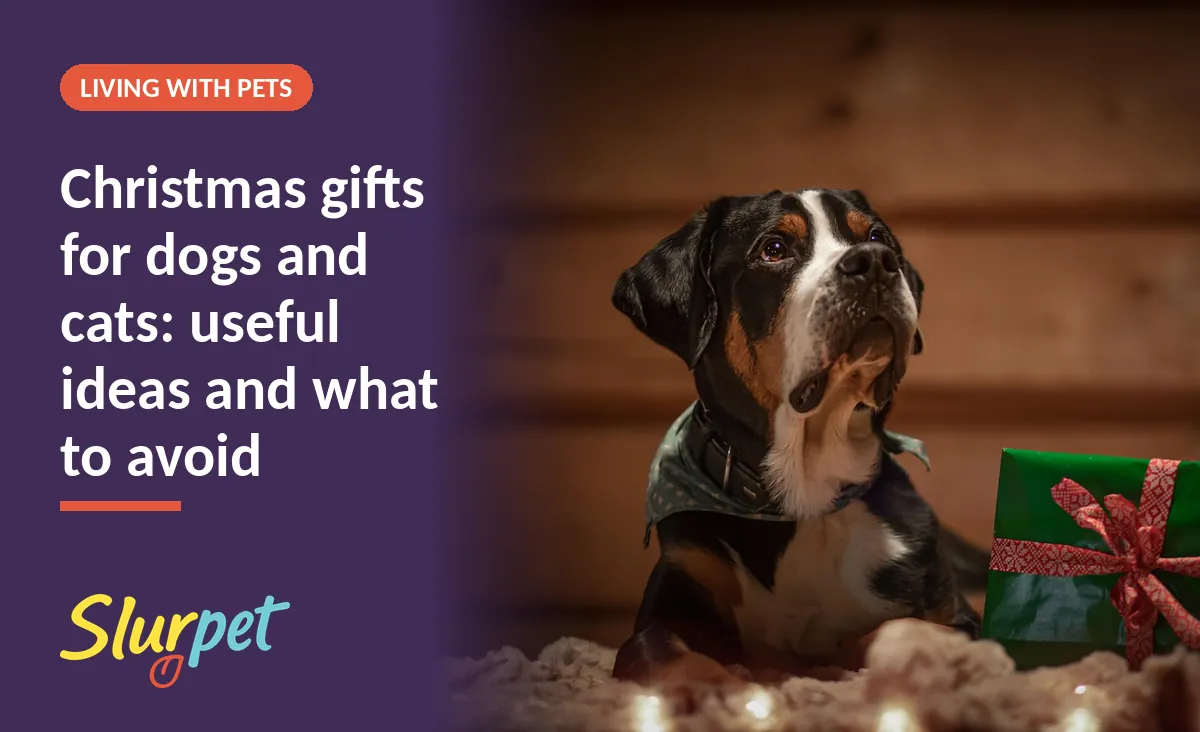
The best Christmas gifts for dogs and cats are safe and suited to the animal: a sturdy toy of the right size, a food puzzle, a comfortable bed, a scratching post or a few treats given in moderation. Avoid cooked bones, toys that are too small, ribbons and string within a cat’s reach and, above all, a pet given as a surprise present.
At a glance
- Choose the gift according to age, size and personality: a puppy, an active adult and a senior all have different priorities.
- A ball must be bigger than the dog’s mouth so it cannot lodge in the throat (PDSA).
- With cats, watch out for string, ribbon and tinsel: if swallowed they can cause a serious intestinal blockage.
- Treats, festive ones included, should make up no more than 10% of daily calories (WSAVA).
- A dog or cat is not a surprise present: animal welfare organisations across Europe repeat this every December.
What is the right Christmas gift for a dog or a cat?
The right gift meets a real need of your pet: moving, chewing, searching for food, resting somewhere warm or scratching. Before wrapping anything, ask yourself three questions: is it safe for their size and the way they play? Will they actually use it? Can you supervise the first few times they use it?
Dogs and cats don’t care about the price, only about what they can do with the object: a toy that engages their nose or hunting instinct, a bed in the right spot or an extra walk is worth more than a gadget bought for the photo.
Which gifts are useful for dogs?
For dogs, the most useful gifts satisfy the need to chew, search and move, and come in the right size. These are the ideas that work best:
- A ball or fetch toy of the right size. The UK veterinary charity PDSA recommends a ball large enough that it cannot fit entirely in the dog’s mouth, but still comfortable to carry. Soft or natural rubber is best. You’ll find some options in Dog toys.
- A food puzzle. A toy you fill with part of the daily kibble makes them work with nose and paws and slows down eating. Start with an easy level so they don’t get frustrated.
- A bed or an extra blanket. In winter a soft spot away from draughts is especially welcome for older and short-haired dogs.
- A coat, if it is really needed. Not every dog needs one: we covered this in Does your dog need a coat?.
- Dental or chew treats suited to their size. Choose a size that fits the dog and count them in the day’s calories. You’ll find them in Snacks for dogs.
- An experience together. A walk somewhere new or a search game with treats hidden around the house.
Which gifts do cats really enjoy?
Cats enjoy gifts that let them hunt, scratch, watch from above and rest somewhere safe.
- A sturdy scratching post. Scratching is a natural need: a tall, stable scratching post placed near the spots your cat already chooses also protects the sofa. Practical tips are in Cat scratching the sofa: why it happens and how to stop it.
- A food puzzle. In a review published in 2016 in the Journal of Feline Medicine and Surgery, Dantas and colleagues describe more than 30 cases in which food puzzles were associated with weight loss, less aggression, less anxiety and fear, and a return to using the litter tray. The authors advise starting with very easy puzzles and increasing the difficulty gradually.
- A soft or raised bed. Many cats love warm, enclosed spaces: a ring bed in a quiet corner is a gift they will use every day. Have a look at our Cat beds.
- A wand toy to play with together. Wands with feathers or small figures mimic prey and are perfect for short sessions, but they need to be put away afterwards (we explain why below).
- A few quality treats. Few, small and counted: in Snacks for cats you’ll also find oral hygiene treats.
How do you choose a gift by age and size?
Age and size change the ideal gift a lot: a teething puppy, an energetic adult and a senior with stiff joints have different needs. This table will help you find your way.
| Life stage or size | Useful ideas | What to watch out for |
|---|---|---|
| Puppy or kitten | Soft but durable toys, easy first food puzzles, a blanket for the bed | Small parts that come off, always supervise toys, treats in tiny amounts only |
| Active adult | Fetch toys, medium-level food puzzles, tug toys for dogs, a wand toy for cats | Toy size relative to the mouth, wear after the first few weeks |
| Senior | Orthopaedic or raised bed, warm blanket, calm sniffing games | Chews that are too hard, games involving jumps or sprints |
| Small dog | Light, well-proportioned toys, mini-size treats | Avoid toys designed for bigger dogs if they are too heavy or hard |
| Large dog | Big, sturdy balls, chews of an appropriate size | Small balls, which can lodge in the throat |
If your dog or cat has dental or weight problems or is on a veterinary diet, ask your vet before choosing treats or chews.
Which gifts are best avoided?
Avoid gifts that can break into pieces, be swallowed or poison your pet. These are the most common under the tree:
- Cooked bones and chews that are too hard. According to the Texas A&M School of Veterinary Medicine, cooked bones can splinter and perforate the digestive tract, while very hard bones can break teeth.
- Balls and toys that are too small. The PDSA warns that a ball that is too small can lodge in the throat. This mainly affects large dogs.
- String, ribbon, wool and tinsel for cats. Long, thin objects can cause a “linear foreign body”, a type of intestinal obstruction that VCA Animal Hospitals describes as especially dangerous. The ASPCA points out that swallowed tinsel can cause severe vomiting and an obstructed digestive tract, and may require surgery.
- Squeaky or stuffed plush toys for dogs that destroy everything. Swallowed squeakers and stuffing can cause blockages (Texas A&M).
- Festive food. Chocolate, grapes, raisins and other Christmas foods are dangerous: the full list is in Chocolate, grapes, onions: foods toxic to dogs and cats.
- Scented candles and essential oil diffusers in a home with a cat. The Pet Poison Helpline explains that cats struggle to metabolise certain compounds in essential oils and that ultrasonic diffusers release microdroplets that can settle on the fur and be swallowed during grooming.
- A live animal as a surprise. We cover this in its own section below.
How many treats can you give without overdoing it?
Even at Christmas, treats should stay below 10% of daily calories: this is the WSAVA (World Small Animal Veterinary Association) guidance for dogs and cats. The rest must come from their complete food, because treats do not replace a meal.
In its owner leaflets, the WSAVA gives these guide limits for a healthy adult animal at ideal weight:
| Animal and weight | Maximum daily calories from treats |
|---|---|
| Dog 2 kg | 14 kcal |
| Dog 10 kg | 47 kcal |
| Dog 20 kg | 79 kcal |
| Dog 30 kg | 108 kcal |
| Dog 45 kg | 146 kcal |
| Cat 2.5 kg | 18 kcal |
| Cat 4 kg | 22 kcal |
| Cat 5 kg | 25 kcal |
| Cat 7 kg | 28 kcal |
To put this in perspective, according to the WSAVA, 28 g of cheddar contains about 120 kcal: for a cat that is several times a whole day’s limit. The WSAVA also notes that many cats are lactose intolerant, so milk and dairy products are best avoided. If you’d like an advent calendar for your pet, choose small treats and reduce meals slightly, as the American Kennel Club also suggests. To work out your cat’s portion, start from How much should a cat eat?.
How do you give gifts safely?
The safest approach is to introduce one gift at a time, under your supervision, and check it over time. This checklist will help:
- Remove labels, tags, ribbons, plastic ties and clips before handing over the toy.
- Don’t leave parcels containing food under the tree: the ASPCA reminds owners that pets can smell them through the paper.
- Stay with your pet the first few times they play or chew; the WSAVA advises supervising dogs with chews, treats and toys.
- Offer one or two toys at a time rather than a full basket, and put them away when not in use, as the Texas A&M vets recommend.
- Always put wand toys with string or feathers away after playing with your cat.
- Check toys regularly: cracks, loose pieces or exposed stuffing are the sign to throw them away.
What should you do if your pet swallows part of a gift?
If your dog or cat is struggling to breathe, choking or has swallowed pieces of a broken toy, contact your vet immediately, as the PDSA recommends. Don’t wait for symptoms and don’t try to make your pet vomit yourself.
With cats, watch for vomiting, refusal to eat, lethargy and dehydration in the following days: these are the signs VCA links to a linear foreign body. If you see a thread sticking out of the mouth or the bottom, don’t pull it: call your vet.
Can you give a dog or a cat as a Christmas present?
Giving a pet as a surprise is not recommended: a dog or a cat lives for many years and should be a considered decision by the whole household, not a parcel under the tree. If adopting has been on your mind for a while, the gift can be a book about the animal, a training course or a visit to a rescue centre together, with the new arrival planned for after the holidays, when the house is calmer.
If you adopt in Italy, dogs must be microchipped and registered: all the steps are in Microchipping and the SINAC register: rules for dogs and cats in Italy.
What happens in other countries?
Across Europe, charities and in some cases laws discourage impulse pet buying at Christmas:
- United Kingdom. The slogan “A dog is for life, not just for Christmas” was created by Dogs Trust in 1978 and is still the symbol of campaigns against impulse gifts.
- Germany. In its press release of 27 November 2025, the German Animal Welfare Federation (Deutscher Tierschutzbund) reminds people that a pet “is not a toy” and that many shelters are already full; as an alternative, it suggests a book about the animal or sponsoring an animal at a shelter.
- France. Anyone buying or receiving a dog or cat for free must sign a certificate of commitment and knowledge and can only take the animal 7 days after it is issued; since 1 January 2024 the sale of dogs and cats in pet shops has been banned (Service-Public.fr).
- Spain. Animal welfare law 7/2023 allows sale or adoption only through professional breeders, authorised specialist shops or animal protection centres, and free transfer only with a contract between the parties; according to the Ministry’s FAQ, dogs, cats and ferrets may only be bought from their breeder.
- Italy. The microchipping and registration requirement for dogs mentioned above applies.
Frequently asked questions
What is the most useful gift for a dog?
It depends on the dog, but a sturdy toy of the right size or a food puzzle suits almost all of them. For seniors, a comfortable bed is often the most appreciated gift.
What can you give a cat that has everything?
Try a food puzzle or a new raised spot near a window. Even 10 minutes a day of play with a wand toy is a gift cats really appreciate.
Are rope toys OK?
For dogs they can be fine under supervision, but if they start to fray, take them away, because swallowed fibres can cause problems. For cats, string should be avoided when they are left alone.
Can I give my dog a bone from Christmas dinner?
No. Cooked bones can splinter and injure the digestive tract. A chew made for dogs, of the right size and counted in the day’s calories, is a better choice.
How many treats can my cat have over the holidays?
No more than 10% of daily calories: for an adult cat weighing 4 kg, the WSAVA suggests about 22 kcal a day. If you add treats, reduce meals slightly.
Remember: this article is for information only and does not replace your vet’s advice.
Slurpet products for Christmas gifts
Here are a few ideas from our range, chosen because they are safe and useful all year round, not just on Christmas Day.
- MP Bergamo Pallotta Maxi ø 7.5 cm: a play ball for medium-sized dogs; always check that it is bigger than your dog’s mouth.
- MP Bergamo Ring bed with cushion: a ring bed for cats and small dogs that love to curl up somewhere warm, also suitable for seniors.
- Orozyme chewable strips size M: oral hygiene chews for medium-sized dogs, to be counted within the 10% of calories from treats.
- Monge Gift Soft Stick Dental rabbit and sage: small sticks for adult cats, handy for an advent calendar with measured portions.
You’ll find more ideas in Dog toys, Cat beds and Snacks for cats.
Sources
- PDSA – How to choose a safe ball for your dog
- Texas A&M School of Veterinary Medicine – Hidden hazards: a guide to the potential dangers of pet toys
- ASPCA – Holiday safety tips
- VCA Animal Hospitals – Linear foreign body in cats
- Pet Poison Helpline – Essential oils and cats
- WSAVA – Feeding treats to your dog
- WSAVA – Feeding treats to your cat
- American Kennel Club – How many treats can a dog have?
- Dantas L.M. et al. – Food puzzles for cats: feeding for physical and emotional wellbeing, Journal of Feline Medicine and Surgery (2016)
- Dogs Trust – Our story
- Deutscher Tierschutzbund / FINDEFIX – Tiere sind keine Weihnachtsgeschenke (27/11/2025)
- Service-Public.fr – Avoir un chien ou un chat : quelles sont les règles ?
- BOE – Ley 7/2023, de protección de los derechos y el bienestar de los animales
- Ministerio de Derechos Sociales – Preguntas y respuestas frecuentes sobre la Ley 7/2023