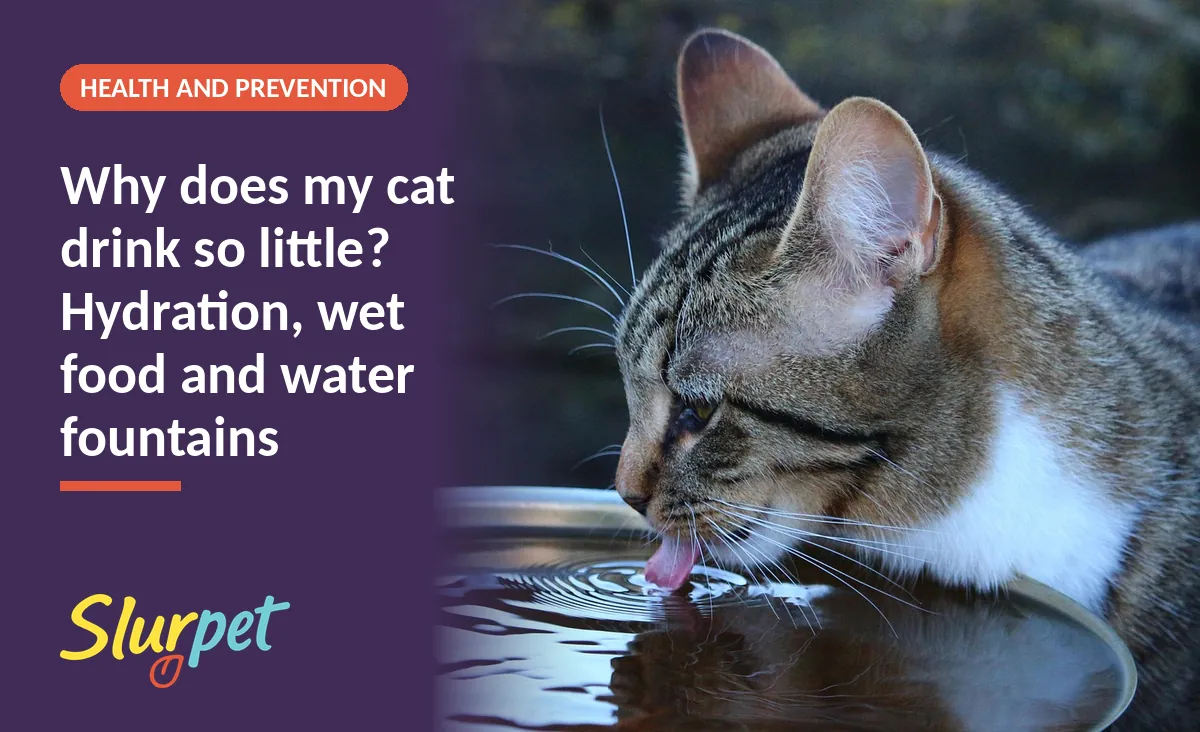
Often, a cat who drinks little is simply a cat who eats wet food: it contains up to 80% water and covers much of their needs. The problem starts when your cat drinks little and eats mainly dry food, or when their habits change suddenly. Here’s how much water your cat needs, how to help them drink more and when to talk to your vet.
At a glance
- A cat needs roughly 50 ml of water per kg of lean body weight each day, including the water in their food: for a 4-5 kg cat, that’s around 200-250 ml.
- Wet food contains at least 75% water, dry food only 6-10%: cats on wet food drink less from the bowl, and that’s normal.
- Some cats enjoy water fountains, but in a controlled study they didn’t increase water intake compared with an ordinary bowl.
- Wide bowls, filled to the brim, away from food and in several spots around the house help more than any gadget.
- If your cat stops drinking and eating, seems lethargic or struggles to pee, call your vet straight away.
Why does my cat drink so little?
Cats drink little mainly because they get plenty of water from their food and are very fussy about where, how and what they drink.
According to the Cornell Feline Health Center, wet food can contain up to 80% water, while dry food contains between 6 and 10%. So a cat on wet food alone can drink very little without being dehydrated, whereas a cat on dry food has to get most of their water from the bowl.
International Cat Care, the international cat welfare charity, notes that many cats dislike their whiskers touching the bowl’s sides, prefer glass or ceramic to plastic, don’t like water near their food and often choose puddle rainwater or running tap water.
The Cornell Feline Health Center lists reasons a cat may drink too little: weakness and lethargy, reduced appetite, dental problems, difficulty reaching the bowls and territorial conflicts with other cats at home.
How much water should a cat drink a day?
A cat needs roughly 50 ml of water per kg of lean body weight daily, counting both drinking water and the water in food.
The Cornell Feline Health Center suggests about 4 ounces of water (around 120 ml) for every 5 pounds (around 2.3 kg) of lean body weight, which works out at one cup (around 240 ml) a day for a 4.5 kg cat. It’s a guide figure that varies with heat, activity, age and health. The table below turns it into practical numbers and shows how much water comes from food in two typical situations.
| Cat’s weight | Total water per day (approx.) | If they eat 2 × 85 g pouches of wet food | If they eat only dry food |
|---|---|---|---|
| 3 kg | 150 ml | around 130 ml from food, the rest (around 20-30 ml) from the bowl | almost all from the bowl |
| 4 kg | 200 ml | around 130 ml from food, around 70 ml from the bowl | almost all from the bowl |
| 5 kg | 250 ml | around 130 ml from food, around 120 ml from the bowl | almost all from the bowl |
| 6 kg | 300 ml | around 130 ml from food, around 170 ml from the bowl | almost all from the bowl |
These figures are approximate: an 85 g pouch with 75-80% moisture contains around 65 ml of water, while 50 g of dry food with 6-10% moisture provides just 3-5 ml. For portion sizes, see the tables in our guide How much should a cat eat?.
No need to measure every sip: what matters is noticing sudden changes in their habits.
Wet or dry food: how much does diet matter for hydration?
Food matters a great deal: on a wet diet, a cat takes in more water overall and produces more dilute urine, even while drinking less from the bowl.
This was measured in a study in the British Journal of Nutrition (Buckley and colleagues, 2011): six cats were given the same food at different moisture levels, from 6.3% to 73.3%. On the wettest food, the cats drank less from the bowl, but total water intake rose significantly and their urine became more dilute (specific gravity of around 1.036 compared with 1.052-1.054 on the other diets). Supersaturation for calcium oxalate, one of the components of urinary stones, also fell.
A paper in the American Journal of Veterinary Research (Zanghi and colleagues, 2018) also notes that, relative to calories, cats fed dry food drink less than cats fed wet food: around 0.6-0.73 ml of water per kcal on dry food compared with around 0.95 on wet food.
That’s why the Cornell Feline Health Center, when discussing urinary stones, suggests that at least 50% of a cat’s diet should be wet food. That doesn’t mean avoiding dry food: plenty of cats do really well on a mixed diet. To combine the two, read Dry or wet food for cats?.
Another simple trick is to add a little room-temperature water to wet food. International Cat Care warns against overdoing it, though: too much water can put your cat off the meal. Go a little at a time.
Do cat water fountains really work?
Some cats like fountains, but they’re no guaranteed fix: in a controlled study they didn’t increase water intake compared with an ordinary bowl.
The study, in the Journal of Feline Medicine and Surgery (Robbins and colleagues, 2019), compared three bowl types in 14 dry-fed cats: a bowl of still water, one with circulating water and a free-falling water fountain. On average the cats drank around 27.5 ml per kg per day from still water, 26.3 from circulating water and 26.1 from the fountain: not a significant difference. However, three of the 14 cats showed a personal preference for one bowl type, not always the fountain.
The authors conclude that bowl type alone doesn’t noticeably change how much cats drink, and suggest offering several types, especially to cats who are unwell. The Cornell Feline Health Center also notes that preferences vary from cat to cat.
If you’d like to try one, introduce it gradually next to the usual bowl, as International Cat Care recommends, and clean it regularly as the manufacturer instructs. If your cat ignores it, don’t push it.
How to get your cat to drink more: a checklist
The most effective approach is to make water easy to find, clean and served the way your cat likes it.
Practical steps recommended by International Cat Care and the Cornell Feline Health Center:
- Choose a wide, shallow glass or ceramic bowl, so your cat needn’t put their head inside and their whiskers don’t touch the sides.
- Fill it to the brim, as International Cat Care advises.
- Place it away from the food bowl and avoid double food-and-water bowls.
- Pick a quiet spot, reachable from all sides and not pushed against a wall.
- In a multi-cat home, offer at least one bowl per cat plus one extra, and put one on every floor.
- Change the water daily: cats prefer fresh water, not water left standing for days.
- Serve water at room temperature; if your tap water is drinkable but your cat refuses it, try filtered or bottled still water.
- Try running water: a fountain or a dripping tap, always under supervision.
- Add more wet food to their diet, or a little water to their food, step by step.
- To make water more tempting, use unsalted chicken or fish cooking water, or the water from tuna in spring water: never salty stock, gravy, milk or anything containing onion.
Does anything change with age or lifestyle?
Yes: age, health and the type of home all change your cat’s needs and what to keep an eye on.
| Situation | What to watch out for | What you can do |
|---|---|---|
| Kitten | In the first few weeks they move from mother’s milk to solid food and learn to drink | A shallow, stable bowl always available; wet food suitable for growth |
| Adult cat on dry food | Gets almost all their water from the bowl | More water stations; consider introducing wet food |
| Indoor cat | Cornell lists cats who live indoors, use a litter tray and drink little among those most prone to urinary problems | Wet food in the diet, fresh water always available, exercise and play |
| Senior cat | May have joint pain, dental problems or illnesses that affect thirst | Raised or easy-to-reach bowls; regular check-ups with the vet |
| Multi-cat home | A cat may avoid water if another cat “guards” the bowl | At least one bowl per cat plus one extra, in different rooms |
For neutered cats, who also have different mealtime needs, see Neutered cat: how feeding changes.
How can you tell if your cat is dehydrated?
A dehydrated cat is often lethargic, eats little and has dry or tacky gums; in severe cases the eyes look sunken.
The Cornell Feline Health Center describes two simple checks you can do at home:
- The skin tent test: gently lift the skin between the shoulder blades and release it. In a well-hydrated cat it springs back almost immediately; if it stays raised for longer, it may signal dehydration. Bear in mind that older cats can have less elastic skin even when well hydrated.
- The gums: touch them with a clean finger. They should feel moist; if they’re dry or tacky, that’s a warning sign.
If you suspect dehydration, Cornell advises contacting your vet straight away.
When should you see the vet?
See your vet if your cat drinks little and shows other signs too, or if their drinking habits change suddenly, either way.
Contact them without waiting if you notice:
- your cat isn’t drinking or eating, or is lethargic and hiding;
- vomiting or diarrhoea, which cause heavy fluid loss;
- signs of dehydration such as dry gums or a slow skin tent;
- straining to pee, repeated trips to the litter tray with little or no urine, blood in the urine or peeing outside the litter tray.
The last point is the most urgent. The Cornell Feline Health Center stresses that a urethral obstruction, when a cat can’t pass urine, is an absolute emergency needing immediate veterinary treatment.
Drinking much more than usual warrants a visit too. International Cat Care advises speaking to your vet whether your cat drinks too much or too little, and Cornell notes that chronic kidney disease, diabetes and hyperthyroidism make the body lose more water, increasing thirst. Only your vet can work out the cause.
What mistakes should you avoid?
The most common mistakes are putting water in the wrong place, relying on one gadget and underestimating a sudden change.
- Water bowl next to food: many cats prefer to drink away from where they eat.
- One bowl for everyone: in a multi-cat home, a single bowl can become a source of conflict.
- Milk “for hydration”: it’s not a substitute for water and International Cat Care advises against it; the same goes for salty stock and gravy.
- Ignoring changes: a cat who suddenly drinks a lot more or a lot less should be checked by a vet.
Frequently asked questions
Is it normal for my cat never to drink?
If your cat eats mainly wet food, it’s normal to see them drink very little, because their food covers most of their needs. If they eat dry food and you never see them drink, or they seem lethargic or are eating less, talk to your vet.
How much water should a 4 kg cat drink?
They need around 200 ml of water a day in total, including the water in food. With two 85 g pouches of wet food they get around 130 ml from food; on dry food alone, they have to drink almost all of it from the bowl.
Do cat water fountains work?
It depends on the cat. In a study of 14 cats, water intake didn’t change between an ordinary bowl and a fountain, but some cats showed a personal preference: worth trying, but not a guaranteed fix.
Can I add water to dry food?
You can try adding a little room-temperature water to the food, a step at a time. Softened kibble should be eaten straight away, though, not left out for hours; if your cat refuses the meal, go back to how it was.
Why does my cat drink from the tap but not from the bowl?
Many cats prefer running or fresh water straight from the tap. Try changing the bowl, its position and how often you refresh the water; if your cat loves running water, a fountain may suit them.
This article is for information only and does not replace your vet’s advice.
Slurpet products to help your cat stay hydrated
A few wet foods from our range that bring more water into your cat’s diet, to choose according to their age and needs.
- Exclusion Mediterraneo Noble Grain wet food Adult with chicken: wet food for adult cats of all breeds, useful alongside dry food to increase water intake at mealtimes.
- Gemon Mousse Sterilised with chicken and liver: a mousse for neutered cats, handy for those who prefer soft textures and easy to mix with a little water.
- Purina Pro Plan Veterinary Diets HC Hydra Care with chicken: from the veterinary range, designed to increase water intake; veterinary diet, to be used only on your vet’s advice.
You’ll find the full selection in Hydration support for cats, Urinary support for cats and Support for sterilized cats.
Sources
- Cornell Feline Health Center, Hydration
- Cornell Feline Health Center, Feeding Your Cat
- Cornell Feline Health Center, Feline Lower Urinary Tract Disease
- Cornell Feline Health Center, Bladder and Kidney Stones
- International Cat Care, How to encourage your cat to drink
- Robbins MT et al., Quantified water intake in laboratory cats from still, free-falling and circulating water bowls, Journal of Feline Medicine and Surgery, 2019
- Buckley CMF et al., Effect of dietary water intake on urinary output, specific gravity and relative supersaturation in the cat, British Journal of Nutrition, 2011
- Zanghi BM et al., Effects of a nutrient-enriched water on water intake and indices of hydration in healthy domestic cats fed a dry kibble diet, American Journal of Veterinary Research, 2018