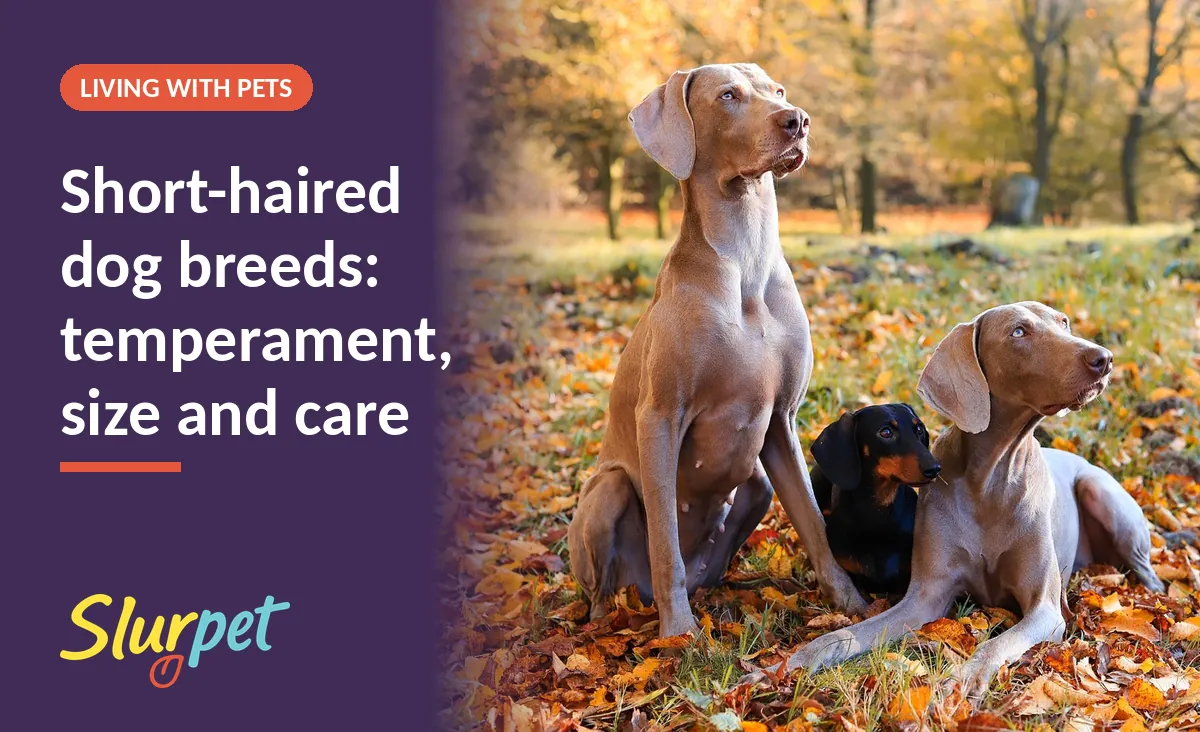
Short-haired dog breeds range from the tiny Chihuahua to the Cane Corso: the Beagle, Boxer, Dobermann, Dalmatian, Jack Russell, Pug, French Bulldog, Whippet and Weimaraner are among the best known. Their temperament and size vary enormously, but coat care is simple for all of them: one brush a week. Just remember that short coats still shed.
At a glance
- “Short-haired” doesn’t mean “doesn’t shed”: the Royal Kennel Club lists almost all of these breeds as shedding, some heavily (Labrador, Pug).
- Grooming usually takes one session a week with a rubber curry brush or grooming mitt; bathe only when your dog is dirty.
- A short coat offers less protection from cold and sun: sighthounds, small breeds, puppies and older dogs may need a coat in winter, and white dogs need protecting from sunburn.
- Flat-faced breeds (Pug, Bulldog, French Bulldog) are more prone to breathing problems and heatstroke.
- Check exercise needs before choosing a breed: they range from under 30 minutes to over 2 hours a day.
Which dog breeds have short coats?
Short-haired breeds have a smooth coat that lies close to the body, with no long feathering to comb. The group is very varied: gundogs and hounds such as the Beagle, Bracco Italiano and Weimaraner; guarding and working dogs such as the Boxer, Dobermann and Cane Corso; sighthounds such as the Whippet and Italian Greyhound; terriers such as the Jack Russell and Staffordshire Bull Terrier; and companion dogs such as the Pug, French Bulldog, Boston Terrier and smooth-coat Chihuahua.
Not all short coats are the same. Some breeds have a single, fine, glossy coat, like sighthounds and the Miniature Pinscher. Others have a short but “double” coat, with a dense undercoat beneath the top coat: the American Kennel Club describes the Labrador’s coat as double-thick and says it changes noticeably twice a year. That’s why two “short-haired” dogs can leave very different amounts of hair around the house.
Which short-haired breeds come in which size?
There’s one for every size, from 2 kg to 50 kg. The table shows measurements from the official FCI (Fédération Cynologique Internationale) breed standards, the country of origin and the exercise needs given by the Royal Kennel Club. Where the standard gives no weight we say so: in those cases the breed is judged mainly on height or proportions.
| Breed | Origin | Height at withers | Weight | Daily exercise (RKC) |
|---|---|---|---|---|
| Chihuahua (smooth coat) | Mexico | not given in the standard | 1–3 kg (ideal 1.5–2.5) | up to 30 minutes |
| Miniature Pinscher | Germany | 25–30 cm | 4–6 kg | up to 30 minutes |
| Italian Greyhound | Italy | 32–38 cm | max 5 kg | up to 1 hour |
| Jack Russell Terrier | England | 25–30 cm | about 5–6 kg | up to 1 hour |
| Pug | China | not given in the standard | 6.3–8.1 kg | up to 1 hour |
| French Bulldog | France | 24–35 cm | 8–14 kg | up to 1 hour |
| Beagle | Great Britain | 33–40 cm | not given in the standard | up to 1 hour |
| Staffordshire Bull Terrier | Great Britain | 35.5–40.5 cm | 11–17 kg | up to 1 hour |
| Whippet | Great Britain | 44–51 cm | not given in the standard | up to 1 hour |
| Bulldog | Great Britain | not given in the standard | about 23–25 kg | up to 1 hour |
| Dalmatian | Croatia | 54–62 cm | not given in the standard | more than 2 hours |
| Labrador Retriever | Great Britain | 54–57 cm | not given in the standard | more than 2 hours |
| Boxer | Germany | 53–63 cm | about 25 to over 30 kg | more than 2 hours |
| Bracco Italiano | Italy | 55–67 cm | 25–40 kg | more than 2 hours |
| Weimaraner | Germany | 57–70 cm | about 25–40 kg | more than 2 hours |
| Dobermann | Germany | 63–72 cm | about 32–45 kg | more than 2 hours |
| Cane Corso | Italy | 60–68 cm | 40–50 kg | not given |
Two notes. The smooth-haired Dachshund isn’t in the table because the FCI standard measures it by chest circumference rather than height, with three sizes (standard, miniature and rabbit). The Boston Terrier, on the other hand, is divided into three weight classes: under 6.8 kg, 6.8 to 9 kg and 9 to 11.35 kg.
What temperament do short-haired breeds have?
Temperament depends on the job a breed was developed for, not on coat length. It helps to think in “families”, following the FCI groups and the descriptions in their standards.
Hounds and gundogs: Beagle, Dalmatian, pointers and Weimaraner
The standard describes the Beagle as alert, intelligent and of even temperament, and the Dalmatian as pleasant, friendly and free from nervousness. Pointing breeds such as the Bracco Italiano, Weimaraner and Hungarian Vizsla are dependable and easy to train, but were bred to work long hours outdoors: the Royal Kennel Club recommends more than two hours of exercise a day for them. They make great companions for people who hike, run or do dog sports.
Guarding and working dogs: Boxer, Dobermann and Cane Corso
The Boxer standard describes a self-assured, even-tempered dog, devoted to its family and wary of strangers; the Dobermann is friendly, calm and very devoted to the family. The Cane Corso protects home, family and livestock. These are big, strong dogs: they need consistent training from puppyhood and plenty of physical and mental exercise.
Sighthounds: Whippet and Italian Greyhound
The Whippet is a gentle, affectionate companion that adapts well to both home life and sporting activities. The Italian Greyhound is described as lively, affectionate and docile. Indoors they’re often calm, but outside they love short sprints, so they need safe, fenced areas to run.
Terriers: Jack Russell and Staffordshire Bull Terrier
The Jack Russell is lively, alert and active, bold but “quietly confident”; the Staffordshire Bull Terrier is courageous, tenacious, intelligent and, according to the standard, affectionate with children. Both pack a lot of energy into a compact body: if they get bored, they’ll find their own entertainment.
Companion dogs: Pug, French Bulldog, Boston Terrier, Chihuahua and Miniature Pinscher
The Pug is even-tempered, happy and lively; the French Bulldog sociable, playful and devoted to its owner; the Boston Terrier friendly and lively. The Miniature Pinscher is self-assured and spirited. They adapt well to flats, but they aren’t “sofa dogs”: they still need daily walks and play.
Which Italian breeds have short coats?
Three FCI-recognised Italian breeds are short-haired: the Bracco Italiano, the Cane Corso and the Italian Greyhound (Piccolo Levriero Italiano). The Bracco Italiano (Group 7, pointing dogs) stands 55–67 cm and weighs 25–40 kg: a dependable, gentle hunting dog that is easy to train. The Cane Corso (Group 2) reaches 64–68 cm and 45–50 kg in males: an agile, responsive guardian of home and family. The Italian Greyhound (Group 10) is the smallest sighthound: 32–38 cm and no more than 5 kg, with a coat so fine that the Royal Kennel Club lists it as a breed that doesn’t noticeably shed.
Do short-haired dogs shed?
Yes, almost all of them. The American Kennel Club points out that “all dogs shed to some degree”, and the Royal Kennel Club’s breed profiles list almost every short-haired breed as shedding. Short hairs are actually very noticeable: they’re stiff and weave themselves into sofa fabrics and coats.
There are big differences between breeds. According to the AKC, Labradors shed “in handfuls” twice a year and should be combed every day during those periods. Pugs also “shed a good bit” despite their very short coats. The Italian Greyhound, on the other hand, sheds very little. If your dog seems to be losing more hair than usual right now, read our guide to autumn shedding in dogs.
How do you care for a short coat, step by step?
A simple weekly routine is all it takes. Blue Cross, the UK animal welfare charity, recommends grooming short-haired, smooth-coated dogs at least once a week. Here’s how to set it up.
- Brush once a week (every day when shedding) with a grooming mitt or rubber curry brush: according to Blue Cross and the AKC these are the best tools for removing dead hair and polishing short coats.
- Follow with a bristle brush to pick up loose hair and spread the natural oils.
- Bathe only when needed: Blue Cross says a bath isn’t always necessary unless your dog is dirty or has skin problems, and the AKC warns that bathing too often strips the coat’s natural oils. For a Labrador living indoors, the AKC suggests a bath every 4 to 6 weeks.
- After muddy or rainy walks a rubdown with a damp cloth is often enough, as the AKC suggests for short-haired dogs.
- Use brushing time for a check: skin, ears, nails, parasites, small wounds or lumps.
- Don’t clip double-coated breeds like the Labrador: the AKC says their coat should never be shaved.
When should you see the vet?
See your vet if you notice bald patches, persistent itching, redness, a lot of dandruff, a bad smell from the skin or a coat that suddenly turns dull. These signs can have various causes (parasites, allergies, diet or hormones), and only your vet can work out which.
How can you tell if a short coat is healthy?
A healthy short coat is easy to recognise by sight and touch, and your weekly brushing session is the perfect time to check it. Here are the signs to look for.
- Shine: a healthy short coat is smooth and reflects the light; a coat that suddenly turns dull or rough deserves a closer look.
- Even coverage: during shedding the coat thins out evenly, whereas clearly defined bald patches aren’t part of normal hair turnover.
- Clean skin: when you part the hair with your fingers, the skin should look smooth, with no redness, scabs, dark specks (possible signs of fleas) or heavy dandruff.
- Smell: a mild “doggy” smell is normal; a strong smell that persists even after a bath isn’t.
- Behaviour: a dog that often scratches, licks or rubs against furniture is telling you something is bothering them.
Make a note of what you see, perhaps with a photo: if something changes over a few weeks, you’ll have useful information to show your vet.
How does care change from puppy to senior?
Basic care stays the same, but the focus shifts at each life stage.
| Life stage | Coat and skin | Cold and heat | Extra attention |
|---|---|---|---|
| Puppy | get them used to the brush, mitt and having paws and ears handled from day one | very young puppies feel the cold more (PDSA) | short, rewarded sessions so grooming becomes enjoyable |
| Adult | weekly brushing, daily during shedding | take care in the hottest hours, especially with flat-faced breeds | adjust food portions to activity and keep an eye on weight |
| Senior | check the skin more carefully: lumps, dry patches, small wounds | older and thin dogs benefit most from a coat (PDSA) | shorter, more frequent walks and regular vet check-ups |
Do short-haired dogs feel the cold?
Some do. The PDSA, the UK veterinary charity, explains that a coat can help dogs with fine or thin fur such as Greyhounds and Whippets, small breeds such as Chihuahuas and small terriers, and dogs that are very young, underweight, old or unwell. A healthy adult medium or large dog, such as a Labrador or Boxer, doesn’t fall into these groups and usually doesn’t need one.
In practice, watch your dog: if they shiver, stop, try to head home or hold their tail and body tucked in, the cold is making them uncomfortable. Shorten the walk, choose milder times of day and consider a well-fitting coat. At home, give them a bed away from draughts and off the cold floor. In the UK and Ireland, where winters are damp and windy, this matters especially for sighthounds and small breeds.
Is the sun a risk for short-haired dogs?
Yes, especially for those with light coats and white skin. The PDSA says the risk of sunburn is highest in dogs with light or thin coats, and the areas most often burned are the ears, nose, eyelids and tummy. The MSD Veterinary Manual notes that sun-induced skin lesions are more common in white-skinned, short-haired breeds such as Dalmatians, Bull Terriers, Pit Bulls and Beagles, and UV exposure is linked to certain skin cancers.
To protect them in summer, the PDSA advises avoiding the middle of the day, walking early in the morning or in the evening, always providing shade and, if your vet thinks it’s useful, applying a pet-safe sun cream to the most exposed areas.
What should you know about short-haired, flat-faced breeds?
The Pug, French Bulldog, Bulldog and Boston Terrier are brachycephalic, or flat-faced, breeds. The University of Cambridge BOAS research group (BOAS stands for brachycephalic obstructive airway syndrome) lists the warning signs: noisy breathing even when awake, poor tolerance of exercise and heat, sleep apnoea, regurgitation and, in severe cases, a bluish tongue or collapse.
Heat is the most immediate danger. A Royal Veterinary College (VetCompass) study of more than 900,000 dogs found that, compared with Labradors, the risk of heatstroke is about 14 times higher in Bulldogs, 6 times in French Bulldogs and 3 times in Pugs. Vets’ advice is simple:
- walk in the cooler hours and, on hot days, reduce how hard your dog exercises (BVA and University of Cambridge);
- before walking on pavement, press your palm on it: if it’s too hot for you, it’s too hot for your dog (BVA);
- never leave your dog in a car, not even for a few minutes (BVA);
- keep your dog fit: according to Cambridge, obesity is linked to more severe BOAS, so weight control is part of prevention.
How long do short-haired breeds live?
It depends a lot on the breed. A large study published in Scientific Reports in 2024, covering nearly 585,000 dogs in the UK, found a median lifespan of 12.5 years across all dogs. Here are the figures for some short-haired breeds in the study’s main table.
| Breed | Median lifespan |
|---|---|
| Italian Greyhound | 14.0 years |
| Miniature Dachshund (all coat types) | 14.0 years |
| Labrador Retriever | 13.1 years |
| Pug | 11.6 years |
| French Bulldog | 9.8 years |
| Bulldog | 9.8 years |
| Cane Corso | 8.1 years |
The same study found that, on average, flat-faced breeds live shorter lives (11.2 years) than breeds with medium-length muzzles (12.8 years). These are population statistics: an individual dog may live longer or shorter depending on genetics, diet, weight and care.
What should a short-haired dog eat?
A complete, balanced food suited to their size, age and activity, because the coat reflects overall health. VCA’s veterinary guides, written with the Canadian Academy of Veterinary Nutrition, explain that protein and fat support skin and coat; that essential fatty acids such as linoleic acid must come from the diet because the body can’t make enough of them; and that the omega-3s EPA and DHA, found in cold-water fish, have an anti-inflammatory effect. Zinc or copper deficiency can also make the coat dull.
Size matters for portions too: a Miniature Pinscher and a Dobermann have very different needs. To work it out, start with our guide on how much a dog should eat and choose from foods for mini size dogs or large size dogs. If the coat is dull or the skin sensitive, you can look at the coat health support for dogs range once your vet has ruled out other causes.
How do you choose the right short-haired breed for you?
Start from your lifestyle, not from how the dog looks. This checklist will help you make a realistic choice.
- Time for exercise: do you have 30 minutes a day or more than two hours? A Miniature Pinscher and a Bracco Italiano have opposite needs.
- Space: a 40–50 kg dog can live in a flat, but needs long walks and open spaces at weekends.
- Experience: large, strong guarding breeds need consistent training, ideally with help from a qualified trainer.
- Climate: if you live somewhere very hot, think carefully about flat-faced breeds; if winters are harsh, sighthounds and small breeds will need protection.
- Hair at home: if dog hair on the sofa bothers you, choose a breed that sheds little or plan for frequent brushing.
- Breed health: ask the breeder which health checks were done on the parents, especially for flat-faced breeds. And remember that rescue centres have plenty of short-haired dogs, pedigrees and crossbreeds alike, looking for a home.
What mistakes should you avoid with a short-haired dog?
The most common mistakes come from thinking a short coat “needs nothing”.
- Never brushing: dead hair stays in the coat, ends up around the house, and the skin never gets checked.
- Bathing too often: frequent washing with unsuitable products dries out skin and coat.
- Clipping a Labrador in summer: double coats shouldn’t be shaved.
- Underestimating heat in flat-faced breeds: even a short walk at the wrong time can become dangerous.
- Ignoring the cold in sighthounds and small dogs: shivering and refusing to walk are signals to listen to.
- Choosing a breed on looks alone: a bored Dalmatian or Weimaraner shut indoors all day can easily become frustrated.
What about other countries?
Short-haired, flat-faced breeds are at the centre of the animal welfare debate in several European countries.
- United Kingdom: the University of Cambridge has developed a respiratory function grading system for the Pug, French Bulldog and Bulldog, which in 2026 was adapted for 14 more breeds. Cambridge researchers say BOAS “exists on a spectrum”, so assessing each dog matters.
- Netherlands: breeding from dogs with muzzles that are too short has been banned since 2019. A rule published in the Dutch Government Gazette (Staatscourant) in August 2023 sets out the criteria, including noisy breathing at rest, narrowed nostrils and a craniofacial ratio below 0.3. According to the Royal Netherlands Veterinary Association (KNMvD), the fine for breeders is €1,500. A ban on keeping these dogs was not yet in force in March 2026: the government has commissioned a study, with results expected in 2028.
- Norway: in 2023 Norway’s Supreme Court ruled that breeding English Bulldogs is allowed only under a specific breeding programme, while it found that breeding Cavalier King Charles Spaniels breaches the Animal Welfare Act.
The message from these countries applies wherever you live, including the UK and Ireland: if you’re choosing a flat-faced puppy, ask about the parents’ breathing health.
Frequently asked questions
Which short-haired dog sheds the least?
Among the breeds in this guide, the Royal Kennel Club lists the Italian Greyhound as a breed that doesn’t noticeably shed. No dog is completely free of shedding, though, and none is guaranteed “hypoallergenic”.
How often should I brush a short-haired dog?
Usually once a week, as Blue Cross recommends. During shedding, for breeds that lose a lot of hair like the Labrador, it’s better to brush every day.
Which short-haired breed suits a flat?
French Bulldogs, Pugs, Boston Terriers, Chihuahuas, Miniature Pinschers and Italian Greyhounds cope well with small spaces. But the individual dog’s energy and the time you can spend outdoors together matter too.
Does a short-haired dog need a coat?
Not always. The PDSA recommends one mainly for dogs with very fine fur, small breeds, puppies, seniors, and thin or unwell dogs. A healthy adult medium or large dog usually doesn’t need one.
Do short-haired dogs need bathing more often?
No. Coat length alone doesn’t decide how often to bathe: according to the AKC, your dog’s lifestyle matters more. Often a damp cloth after walks and a bath when they’re really dirty are enough.
This article is for information only and doesn’t replace your vet’s advice. If you notice skin problems, unusual hair loss or breathing difficulties, contact your vet.
Slurpet products for short coats
A healthy coat starts in the bowl: here are some complete foods from our range, to choose according to your dog’s size and needs.
- Primordial dry dog Adult Mini with sardines and goose 2 kg: for small adult dogs such as Miniature Pinschers, Jack Russells or Chihuahuas, with fish among its protein sources.
- Purina Pro Plan Medium Adult Sensitive Skin Salmon 3 kg: designed for medium-sized adult dogs with sensitive skin, such as Beagles or Staffordshire Bull Terriers.
- Monge BWild Low Grain All Breeds Adult Deer 2.5 kg: for adult dogs of all sizes, from the French Bulldog to the Bracco.
You’ll find more options in the Coat health support for dogs and Skin care support for dogs categories. Supplements in the Skin and fur category are best discussed with your vet.
Sources
- FCI breed standards: Bracco italiano, Cane Corso, Italian Greyhound, Beagle, Boxer, French Bulldog, Dachshund
- Royal Kennel Club, Breeds A to Z (breed profiles on exercise, grooming and shedding)
- American Kennel Club, How to groom a dog and How to groom a Labrador Retriever
- Blue Cross, Grooming your dog
- PDSA, Does my dog need to wear a coat on winter walks? and Sunburn in pets
- MSD Veterinary Manual, Epidermal and hair follicle tumors in animals
- VCA Animal Hospitals, Nutrition, skin and dogs
- University of Cambridge, BOAS: recognition and diagnosis and management and treatment
- Royal Veterinary College, VetCompass, Flat-faced dogs at increased risk of heat stroke
- BVA, If in doubt, don’t go out
- McMillan K.M. et al. (2024), Longevity patterns in companion dogs across UK breeds, Scientific Reports 14:531
- NVWA, Kortsnuiten; Staatscourant 2023 no. 23619, Beleidsregel fokken kortsnuitige honden; KNMvD; parliamentary answers of 9/3/2026
- Supreme Court of Norway, HR-2023-1901-A (10/10/2023)
- University of Cambridge (2026), Vet School researchers advancing knowledge of BOAS in dogs