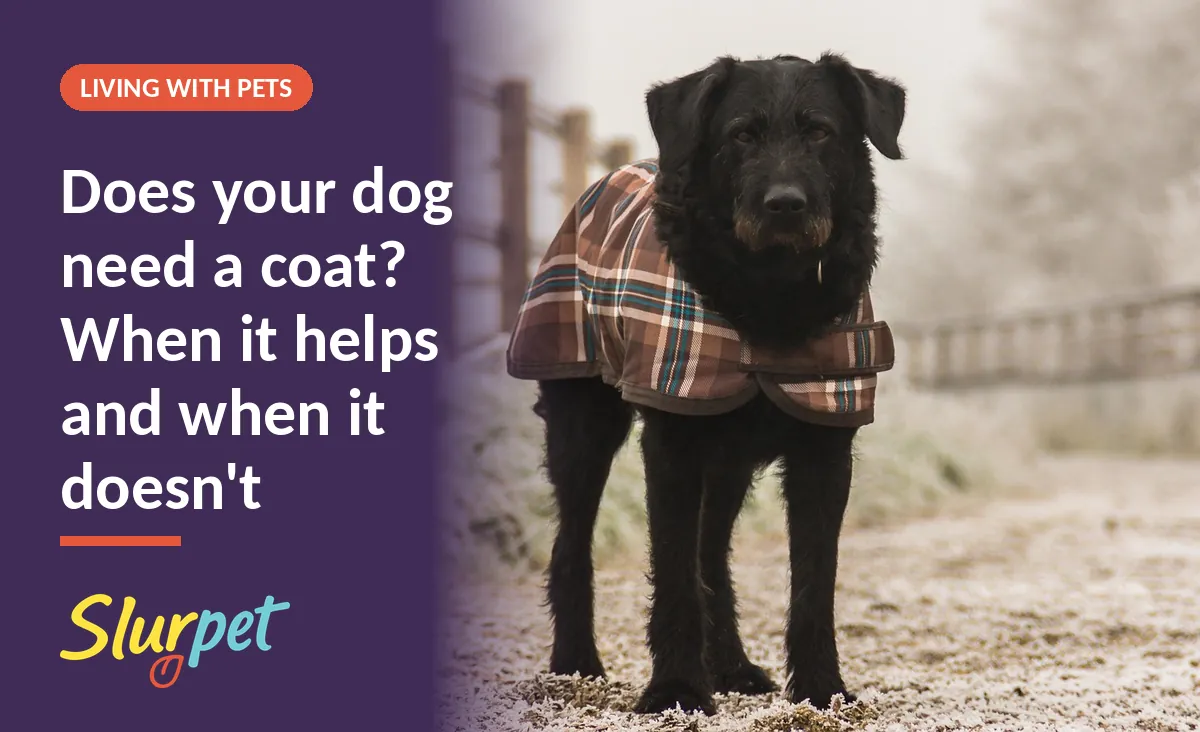
A dog coat is most useful for small dogs, short-coated or clipped dogs, very lean breeds, puppies, older dogs and dogs with health problems when it’s cold, wet or windy. A healthy adult dog with a thick coat that keeps moving usually doesn’t need one. What counts is your individual dog and the weather.
At a glance
- Sighthounds such as Whippets and Greyhounds, Chihuahuas and small terriers, clipped dogs, puppies, seniors and underweight or unwell dogs need a coat the most.
- Huskies, Malamutes, Newfoundlands, St Bernards and Bernese Mountain Dogs have coats bred for the cold and usually manage fine without.
- There’s no single temperature that applies to every dog: wind, rain, how long you’re out and how much your dog moves all matter.
- To find the right size, measure from the neck to the base of the tail, around the chest just behind the front legs, and around the neck.
- Take the coat off indoors and never leave a wet one on: a soaked coat can make your dog feel even colder.
Does your dog really need a coat?
It depends on the dog: fur alone doesn’t tell you whether they’ll feel the cold. The American Veterinary Medical Association (AVMA) calls the belief that fur makes dogs resistant to low temperatures “untrue”: long-haired or thick-coated dogs tend to cope better but are still at risk, while short-haired dogs feel the cold faster.
To decide, look at four things together: the coat, size and body shape, age, and health. Then check the day’s weather: a dry morning at a few degrees above freezing feels very different from a wet, windy afternoon at the same temperature.
Which dogs need a coat?
Dogs that produce or hold on to little body heat benefit most. PDSA, the UK veterinary charity, and the American Kennel Club (AKC) highlight these groups:
- Dogs with fine or very short coats and little body fat: Whippets, Greyhounds, Azawakhs.
- Small and toy breeds: according to PDSA, Chihuahuas and small terriers “can feel the cold quickly”; Hill’s also mentions French Bulldogs among thin-coated dogs.
- Short-legged dogs: Dachshunds, Basset Hounds and, according to the AKC, Corgis too: their belly and chest stay close to snow and puddles.
- Clipped or hairless dogs: Poodles with a short clip, shaved dogs, hairless breeds such as the Chinese Crested.
- Very athletic short-coated dogs: the AKC mentions the Vizsla and the German Shorthaired Pointer.
- Puppies and senior dogs of any breed: PDSA and the AKC both list them among the dogs that need more protection; the AKC also mentions dogs with arthritis as likely to benefit from a coat.
- Underweight or unwell dogs: the AVMA notes that diabetes, heart or kidney disease and hormonal conditions such as Cushing’s disease make animals more vulnerable to the cold. In these cases, ask your vet for advice.
Which dogs can do without a coat?
Healthy adult dogs with a thick coat and undercoat usually don’t need one. PDSA puts it simply: a fit and healthy dog with thick fur should be fine outside without a coat, as long as they’re active.
The AKC and Hill’s point to breeds developed for cold climates: Siberian Huskies, Alaskan Malamutes, Newfoundlands, St Bernards and Bernese Mountain Dogs. A padded coat on these dogs is more likely to make them overheat.
There are exceptions even among “fluffy” dogs: an older, recovering or very lean dog may need protection, and a dog that gets soaked in the rain may benefit from a simple raincoat.
At what temperature does a dog need a coat?
There’s no single threshold that applies to all dogs: a vet interviewed by the AKC says so, and neither PDSA nor the AVMA gives a specific number.
As a rough guide, a chart published by the pet insurer Fetch (formerly Petplan), based on a scale developed at Tufts University, indicates that small and medium-sized dogs can face risks such as hypothermia and frostbite at around 40 °F (about 4 °C), while for larger dogs it recommends keeping walks brief from about 30 °F (about -1 °C). The same source advises checking the wind chill first, as wind makes it feel colder.
In practice, beyond the thermometer, wind, wet and movement matter: a dog running off the lead generates heat, while one walking slowly on the lead or standing still in the park cools down sooner. The table gives a practical guide to adapt to your own dog.
| Type of dog | Cool and dry | Rain or wind | Below freezing or snow |
|---|---|---|---|
| Healthy adult, thick coat, medium or large | Usually not | Usually not; a raincoat if they get very wet | Usually not, keep walks active |
| Short-coated adult, medium or large | Usually not | Consider a raincoat | Often useful, especially at a slow pace |
| Small or short-legged | Useful if they feel the cold | Recommended | Recommended, short walks |
| Sighthounds, very lean, clipped or hairless dogs | Often useful | Recommended | Recommended, short walks |
| Puppy, senior or dog with health problems | Case by case | Recommended | Recommended; ask your vet |
This is general guidance based on PDSA, the AKC and the AVMA: the most reliable signal is still your dog’s behaviour.
Coat, raincoat or jumper: which should you choose?
Choose based on where you live and what your dog does. PDSA and the AKC describe several types:
- Lightweight raincoat: keeps off rain and mud without adding much warmth. In mild, rainy climates it’s often the most useful option, even for dogs that don’t mind the cold but get soaked.
- Padded or fleece coat: insulates against the cold. Many all-purpose models combine a waterproof, windproof outer layer with a warm lining.
- Jumper: according to Hill’s it can be enough when it’s cool; for freezing temperatures, snow, hail or cold rain a proper jacket is better. Wet wool keeps them less warm.
- Snowsuit or bodysuit: also covers the legs and belly; the AKC suggests it for very lean or hairless dogs.
- High-visibility coats: handy during short winter days, when walks often happen in the dark.
Useful details mentioned by the AKC: reflective trim, a harness opening and a cut that leaves the toileting areas free. A machine-washable fabric is also practical.
How do you measure your dog for a coat?
You need three measurements, taken with a soft tape measure while your dog is standing. Here’s how, following PDSA’s advice:
- Back length: from where the collar sits to the base of the tail.
- Chest girth: at the widest point, just behind the front legs.
- Neck girth: where the collar normally sits.
- Check the manufacturer’s size chart: sizes vary between brands. If your dog falls between two sizes, the chest measurement matters most.
- Do a test run: your dog should be able to walk, run, sit and go to the toilet without any trouble.
Hill’s recommends a coat that’s snug enough to trap body heat but not so tight that it restricts movement or circulation; the AKC warns it shouldn’t be so loose that it can get tangled. If your dog scratches or bites at the coat, PDSA says it probably doesn’t fit properly. Sighthounds and long-bodied dogs often need coats cut specifically for them.
How do you get your dog used to wearing a coat?
Calmly and positively, as the AKC recommends. Here’s a simple sequence:
- Let your dog sniff the coat on the floor and reward them with a treat.
- Lay it on their back for a few seconds without fastening it, then take it off and reward.
- Do up the buckles or Velcro at a calm moment, away from walk time, and gradually increase the time.
- Put it on just before going out, so your dog links it with something good.
- If your dog freezes or scratches a lot, go back a step and check the size is right.
If your dog pulls on the lead, a coat won’t change that: you’ll find some exercises for a calmer walk in our article on dogs pulling on the lead.
Which mistakes should you avoid with a dog coat?
The most common mistakes involve wearing it indoors, damp and the wrong size:
- Keeping it on indoors: according to PDSA, most dogs don’t need a coat inside because they quickly overheat in centrally heated homes. Take it off when you get back.
- Using it wet: the AVMA warns that wet jumpers or coats can actually make your dog colder. If you go out several times a day, keep a dry spare.
- Putting it away damp or never washing it: the AKC recommends washing it regularly to avoid skin irritation, as a coat stored damp can harbour bacteria.
- Getting the size wrong: too tight and it rubs under the front legs and restricts movement; too loose and it slips and snags.
- Dressing a dog that doesn’t need it: a Husky in a puffer jacket may overheat while running.
- Leaving it on an unsupervised dog: left alone, a dog may chew it or get caught up in it.
How can you tell if your dog is cold?
The most obvious sign is shivering. According to the AVMA and Hill’s, dogs that are cold may:
- shiver or tremble;
- slow down, stop or want to turn back;
- lift their paws off the ground in turn;
- whine or seem anxious;
- look for shelter, curl up or burrow under a blanket as soon as they get home.
PDSA advises heading home as soon as you notice shivering or slowing down. If your dog seems weak or stops moving, possible signs of hypothermia according to the AVMA, get them somewhere warm, wrap them in a blanket and contact your vet. Frostbite, the AVMA notes, may only become apparent a few days later.
What about paws? Ice, grit and antifreeze
Paws need protecting too. The AVMA suggests:
- wiping paws, legs and belly after a walk with a damp cloth to remove salt and de-icing products your dog might lick off;
- checking the pads: report any cracks or bleeding to your vet;
- watching for ice balls forming between the toes, which can cause sudden lameness; trimming the fur between the pads helps;
- keeping antifreeze out of reach, because even small amounts can be deadly: watch out for puddles in garages and car parks;
- using boots if needed, in the right size; Hill’s recommends a sole with good grip.
Puppies, adults and seniors: what changes?
Age makes a big difference to how well a dog copes with the cold, as does size. Here’s a practical summary based on PDSA, AKC and AVMA guidance:
| Life stage | What to consider | Practical tip |
|---|---|---|
| Puppy | Listed by PDSA and the AKC among the dogs most sensitive to cold | Short outings; a light coat if small or short-coated |
| Healthy adult | Depends on coat, size and activity | Moving is often enough; a raincoat in persistent rain |
| Senior | More sensitive to cold; the AKC also mentions arthritis | A coat helps even sturdy breeds; shorter, more frequent walks |
| Dog with a chronic illness or recovering | More vulnerable to cold according to the AVMA | Ask your vet how to manage walks and protection |
If your dog is getting older, you’ll find more advice on their changing needs in our article on senior dogs and their diet.
Practical tips for winter walks
A coat is only part of protecting your dog from the cold. A few more habits help every dog:
- Pick the mildest hours: the Fetch chart suggests walking during the warmest part of the day.
- Go for shorter, more frequent outings when it’s very cold, as PDSA advises, rather than one long walk.
- Make your dog visible in the dark with reflective details or a collar light.
- Don’t leave them in the car: the AVMA points out that in winter a cold car can rapidly chill your pet.
- If your dog spends a lot of time outdoors, the AVMA notes they may need more calories: talk to your vet about adjusting their portions.
Frequently asked questions
Can my dog wear a coat indoors?
It’s best not to. PDSA explains that in heated homes most dogs quickly overheat with a coat on. Take it off when you get in and, if it’s wet, let it dry.
Is a jumper or a raincoat better?
It depends on the weather. A jumper may be enough when it’s cool and dry; in rain, wind or snow a waterproof coat, padded if needed, is more useful, because a wet garment keeps your dog less warm.
My dog shivers even with a coat on: what should I do?
Cut the walk short and get them somewhere warm. Check the coat is dry and the right size. If the shivering continues at home, or you notice weakness or lethargy, contact your vet: shivering isn’t always caused by the cold.
Does my dog need boots too?
Not always. They can help on snow, ice and gritted roads, as long as they fit well and have a non-slip sole. Otherwise, clean and dry your dog’s paws after every walk.
This article is for information only and does not replace your vet’s advice. If your dog is elderly, has a chronic illness or shows signs of being very cold, ask your vet how best to protect them.
Slurpet products for dogs that feel the cold
A coat protects from the outside, but small dogs, puppies and seniors also have different needs at mealtimes. Here are some complete foods from our range designed for them:
- Royal Canin Mini Puppy 800 g: for small-breed puppies, among the dogs that feel the cold most on their first winter walks.
- Primordial Adult Mini with quail and duck 2 kg: for small adult dogs such as Chihuahuas, Miniature Pinschers or small terriers.
- Monge Mini Senior Chicken 3 kg: for small senior dogs, who need a little extra care in winter.
You’ll find more options in the Mini size dog and Puppy dog categories; for beds and other items for the home, take a look at Dog accessories.
Sources
- PDSA, Vet Q&A: Does my dog need to wear a coat on winter walks?
- American Kennel Club, Does my dog need a winter coat? Choosing the best winter coat for your dog
- Hill’s Pet Nutrition, Does my dog need a winter coat?
- American Veterinary Medical Association (AVMA), Cold weather animal safety
- Mental Floss, This handy chart tells you when it’s too cold to walk your dog (Fetch chart based on the Tufts University scale)